Context Window vs RAG vs Fine-Tuning: What to Choose

Three ways to teach an LLM to work with your data and tasks - put everything in the context window, connect RAG (retrieval-augmented generation), or fine-tune the model. Each approach has its own cost, speed of knowledge updates, and accuracy ceiling. Below is how they work, how they differ, and how to pick a strategy for a chatbot, support assistant, or internal copilot without overspending.
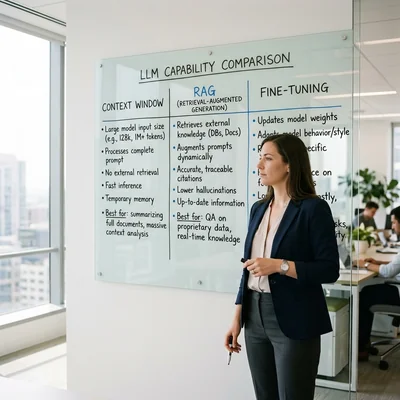
Three Approaches to One Problem
The goal is the same: the model must answer questions about your product, documentation, policies, or domain - not only what was in pre-training. The options:
| Approach | Idea | Where knowledge lives |
|---|---|---|
| Context window | All needed text in the prompt | In each request |
| RAG | Retrieve relevant chunks + generate | In the index / knowledge base |
| Fine-tuning | Retrain model weights | In model weights |
Often you choose not "or" but a combination: RAG for facts, fine-tuning for style and format, long context for a small document set in one request.
Context Window: Everything in the Prompt
The context window is the amount of text (in tokens) the model "sees" in one request: system prompt, chat history, attached files, and instructions.
How It Works
You put in the prompt:
- system instructions ("answer as company X's legal counsel");
- relevant documents in full or large chunks;
- few-shot examples ("here is a good answer sample").
Modern models (GPT-5.6, Claude Fable 5, Gemini 3.5 Flash) support 1-2M token context - hundreds of pages. For many scenarios that is enough without separate infrastructure.
Pros
- Minimal infrastructure - no vector index or embedding refresh pipeline.
- Instant updates - change prompt text and knowledge updates immediately.
- Transparency - you know exactly what the model "sees" in this request.
- Few-shot without training - examples in the prompt set answer format.
Cons
- Cost grows with length - long-context pricing from providers is often x1.5-x2 base.
- Volume ceiling - even 2M tokens will not hold an entire enterprise knowledge base.
- Quality on the needle - models may "lose" details in the middle of very long context (lost-in-the-middle).
- Latency - more input tokens means slower time to first token.
When to Choose Context
- Small, stable corpus: 5-50 documents, one product, one FAQ.
- Prototype or MVP - validate a hypothesis in a day without a RAG stack.
- Tasks needing full text in one request: compare two contracts, code review of an entire PR.
- Need full control over what enters the prompt (audit, compliance).
RAG: Search + Generation
RAG - before answering, the system searches for relevant fragments in your base (vector search, BM25, hybrid), inserts them into the prompt, and the model generates an answer grounded in what was found.
How It Works
Typical pipeline:
- Ingestion - documents split into chunks (300-1000 tokens), embeddings built.
- Index - vector DB (Pinecone, Qdrant, pgvector, Chroma) + optional keyword index.
- Query - user question -> embedding -> top-k chunks.
- Generation - chunks + question -> LLM -> answer (ideally with source citations).
Knowledge updates: reindex changed documents - no model retraining.
Pros
- Scale - millions of pages if indexing and chunking are done right.
- Freshness - new document in the index in minutes, not weeks.
- Fewer hallucinations - model relies on provided fragments; citations increase trust.
- Input savings - only relevant chunks go into the prompt, not the whole base.
Cons
- Complexity - chunking, embeddings, reranking, evaluation, drift monitoring.
- Retrieval quality = answer quality - bad search gives bad answers with a "perfect" model.
- Latency - two steps (search + generate) plus rerank.
- Duplicates and conflicts - different document versions in the index confuse the system.
When to Choose RAG
- Large or frequently changing base: docs, wiki, tickets, Confluence, PDF archive.
- Need source links in answers (support, legal, medical with caveats).
- Many users and queries - cheaper to pull 5 chunks than 500 pages into context.
- Data must not be baked into model weights (confidentiality, tenant isolation).
Fine-Tuning: Knowledge in Weights
Fine-tuning - further training of a base model on your data: instruction/response pairs, dialogues, domain text. Weights shift so the model better knows style, terminology, and typical tasks without a long prompt.
Options:
- Full fine-tuning - all parameters (expensive, rarely needed).
- LoRA / QLoRA - adapters on a frozen base (standard for custom models).
- DPO / RLHF - alignment to preferences (tone, safety, format).
How It Works
- Build a dataset: Q&A, support dialogues, code examples, JSON responses.
- Train adapter or full model on GPU (hours to days).
- Deploy fine-tuned endpoint or merged weights.
- At inference - short system prompt, model already "knows" patterns.
Fine-tuning does not replace current facts: prices, API versions, product news are not reliably "memorized" without RAG or fresh context.
Pros
- Style and format - unified tone of voice, JSON schema, answer templates.
- Fewer prompt tokens - no long instructions and dozens of few-shot examples.
- Latency and cost per request - shorter prompt for the same task.
- Specialized terminology - medicine, law, internal jargon.
Cons
- Expensive and slow - data, GPU, iterations, eval; ML skills required.
- Staleness - new product = new training cycle or hybrid with RAG.
- Overfitting risk - model "memorizes" training set and generalizes poorly.
- Weaker on rare facts - fine-tuning is worse than RAG for "find paragraph 4.2 in policy v3".
When to Choose Fine-Tuning
- Stable task with repeating format: classification, extraction, templated summarization.
- Need short prompt and low latency at millions of requests.
- Large volume of quality labeled dialogues (thousands+ examples).
- On-prem or air-gapped - one local model without external API per chunk.
Comparison by Key Criteria
| Criterion | Context | RAG | Fine-tuning |
|---|---|---|---|
| Knowledge volume | Up to window limit | Practically unlimited | Limited by training set |
| Freshness | Instant (new prompt) | Fast (reindex) | Slow (retrain) |
| Startup cost | Low | Medium | High |
| Request cost | Grows with context length | Search + short context | Low prompt |
| Hallucinations | Medium risk | Lower with good retrieval | Medium, "confident" errors |
| Source citations | Manual in prompt | Natural | Hard |
| Infrastructure | Model API | Vector DB, pipeline | GPU, MLOps |
| Compliance / audit | Full prompt control | Retrieval logs | Weights black box |
Practical Decision Matrix
Start with context if:
- few documents fit in 100-200K tokens;
- you need a POC in one sprint;
- each request is unique and needs "the whole file" (diff, contract).
Add RAG if:
- the base grew or updates weekly;
- users ask about specific facts from thousands of pages;
- you need citations and lower hallucination rate.
Add fine-tuning if:
- answer format is strict and identical on 95% of requests;
- RAG works but the prompt swells with instructions and examples;
- you have a dataset and budget for eval iterations.
Typical production stack 2026:
Fine-tuned model (style + routing)
    + RAG (facts from knowledge base)
    + Moderate context (system prompt, last N messages, 1-2 full docs when needed)
Common Mistakes
- "We will dump everything into 1M context" - expensive, slow; retrieval quality is often better on the same budget.
- Fine-tune instead of RAG for FAQ - model "memorizes" stale prices; RAG or context is simpler.
- RAG without eval - without metrics (recall@k, faithfulness, human review) the system degrades quietly.
- Chunks too small - paragraph meaning is lost; too large - noise in the prompt.
- Ignoring reranking - top-5 from vector search without cross-encoder is often worse than BM25 + rerank hybrid.
When Not to Rush Into RAG or Fine-Tuning
- Little data, few questions. A handful of documents and rare user questions - a long context prompt is enough; RAG infrastructure and fine-tuning will take a while to pay off.
- No process owner. RAG needs someone watching index freshness, fine-tuning needs someone watching dataset quality; without a dedicated owner, answer quality degrades quietly.
- Product and data are still unstable. While prices, processes, and wording change often, fine-tuning is especially risky - every change means a new training cycle; at this stage a short context and prompt edits pay off better.
- No time for quality evaluation. Recall, answer accuracy, and testing on real questions take iteration; if you need results "in a week, no follow-up work," start with the simplest option - the context window - and add RAG and fine-tuning as load grows.
Summary
Context window - fast start and full control for small volumes. RAG - standard for scalable knowledge bases with fresh facts and citations. Fine-tuning - investment in stable behavior and format, not an encyclopedia of facts.
For most corporate assistants, RAG + short system prompt is optimal; fine-tuning is added when measurable gains in quality or request cost justify training. Long context is used selectively - for tasks needing a whole document in one shot, not as a replacement for search across the whole organization.
If you need help with development, AI implementation, or website support for your project - contact me.
Frequently Asked Questions
Can RAG be replaced with a very long context window?
Theoretically - for small corpora. In practice - rarely worth it: cost and latency grow linearly with prompt length, and models use information from the middle of long context less well. RAG pulls only what is relevant and scales to large archives. Exception - "read the whole file" tasks: code review, comparing two contract versions, analyzing one 200-page PDF.
Is fine-tuning required for a corporate chatbot?
Not necessarily at the start. Most internal copilots and support bots are covered by RAG + a good system prompt. Fine-tuning makes sense when you have thousands of reference dialogues, need a unified format (JSON, tickets, CRM fields), or token savings per request are critical. Measure baseline with RAG first - fine-tuning without metrics often does not pay off.
What is cheaper: RAG or fine-tuning?
RAG is cheaper upfront: vector DB, embeddings API, no GPU cluster. Fine-tuning costs more to start (data, training, deploy) but can lower cost per request if it removes long instructions and few-shot from every prompt at high traffic. Compare TCO over 6-12 months: RAG infra + embedding refresh vs retrain cost and fine-tuned model inference.
How often must knowledge be updated for each approach?
Context - on every request (current prompt) or when deploying a new template version. RAG - as documents change: incremental reindex from minutes to hours; full rebuild on schedule or when switching embedding model. Fine-tuning - when behavior or domain changes: weeks to months between releases; facts (prices, releases) still come via RAG or tool calls.
Can all three approaches be combined?
Yes, and the best production systems do. Fine-tuned model sets style and routing ("is knowledge base search needed"). RAG brings fresh fragments. Context holds system rules, chat history, and sometimes one full document for "read entirely" tasks. The key is clear roles: facts from RAG, behavior from fine-tuning, constraints and few-shot from prompt - without duplicating the same text across all layers.
Terms in this article
LLM — Large Language Model
context window — maximum text a model can process at once
fine-tune — train a model further on domain data
chatbot — conversational bot interface
pre-training — large-scale training of a model before task fine-tuning
knowledge base — structured repository of answers/docs
chunks — small text pieces indexed for retrieval
fine-tuning — additional training of a model on domain data
system prompt — hidden instructions that steer the model for a task
few-shot — prompting with a few examples
pipeline — sequence of processing stages
long-context — model that can take a very large prompt in one go
latency — delay before a response arrives
code review — peer check of a change before it is merged
MVP — Minimum Viable Product
embeddings — numeric vectors that capture text meaning
vector db — database for similarity search over embeddings
chunking — splitting documents into retrieval-friendly pieces
top-k — keep only the k most likely next tokens when sampling
reranking — reordering search results by relevance
retrieval — finding relevant context before generation
Confluence — Atlassian wiki for team documentation
inference — running a trained model to get predictions
QLoRA — Quantized Low-Rank Adaptation
endpoint — specific API URL that accepts requests
LoRA — Low-Rank Adaptation
RLHF — Reinforcement Learning from Human Feedback
GPU — Graphics Processing Unit
air-gapped — network fully isolated from the public internet
on-prem — software hosted in your own infrastructure
ML — Machine Learning
hallucination — model invents unsupported facts
production — live environment serving real users
PoC — proof of concept / pilot
RAG — Retrieval-Augmented Generation
vector search — finding nearest neighbors in embedding space
cross-encoder — rerank model that scores query and document together
long context — model that can take a very large prompt in one go
baseline — reference measurement before changes
TCO — Total Cost of Ownership