SEO for Business Owners: What Really Drives Leads from Google and Yandex

SEO (search engine optimization) is not a "magic top-ranking button" or a monthly PDF with position charts. For a business owner, SEO only makes sense when Google and Yandex bring leads, calls, and sales - not just "traffic growth" to articles that nobody converts. In 2026, algorithms weigh site speed, page relevance, brand trust, and user behavior; ads and AI search pressure organic results, but commercial queries still feed small and mid-size businesses. Below is what really affects leads, what agencies often sell "for reporting," and which numbers to check in dashboards without being an SEO specialist.
- Main goal - leads from commercial pages (services, catalog, pricing), not rankings for informational queries
- Google - stronger in global and mobile search; Core Web Vitals and structured data matter
- Yandex - significant in Russia, Belarus, Kazakhstan, Uzbekistan; behavioral factors, maps, and reviews matter
- Five levers - technical base, commercial content, trust, page conversion, local/brand demand
- Typical budget - $500-3,000/mo for a small business with a working site; first meaningful leads - 3-6 months
- Main risk - paying for "10 keywords in top" without site fixes, an SEO audit, and analytics integration
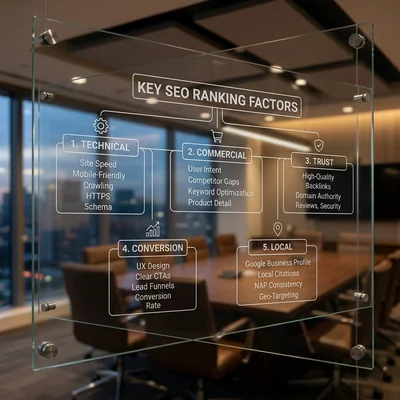
SEO Through the Lens of Leads, Not Rankings
An agency sends a screenshot: "query buy CRM moved from 15th to 8th." The owner celebrates, but leads did not grow. Why:
- A page in 8th place gets far fewer clicks than top 3, especially when aggregators and marketplaces sit above.
- Traffic lands on a blog post "what is CRM," not on "CRM implementation turnkey" with a form.
- The lead form breaks on mobile, the manager replies next day, UTMs are missing - SEO "delivered," CRM "did not record."
Rule for the director: one SEO success metric - target organic leads (or calls tagged "found in search") divided by spend. Rankings and clicks are intermediate metrics.
| Metric | Why look at it | Dangerous interpretation |
|---|---|---|
| Rankings for 10 keywords | Track visibility trend | "All good" with zero leads |
| Organic clicks (GSC / Webmaster) | Search entry volume | Click growth on info posts without sales |
| Organic conversions (GA4 / Metrica) | Real business outcome | Ignored because "SEO team is not responsible" |
| Revenue / deals from organic | ROI | Only valid with clean CRM data |
Google and Yandex: What Owners Should Consider
In one region you often need both channels, but priorities differ.
- Share: stronger in mobile search, international queries, Android audience, expat segments.
- Tools: Google Search Console, GA4, Business Profile (for local business).
- Pressure points: speed (Core Web Vitals), mobile version, HTTPS, clear URL structure, schema.org, content quality (E-E-A-T).
- AI search: Google AI Overviews take clicks from informational queries - commercial pages and brand matter more than "10 articles for traffic." More in the GEO article.
Yandex
- Share: noticeable in Russia, CIS, parts of Uzbekistan and Kazakhstan; for some users - habit and integration with maps/taxi/delivery.
- Tools: Yandex Webmaster, Yandex Metrica, Yandex Business (maps, reviews).
- Pressure points: on-site behavior (time, bounce, return to SERP), regionality, commercial factors (prices, contacts, delivery), snippet quality.
- Local: for clinics, auto service, food delivery, map listings and reviews often bring more calls than classic "20-keyword promotion."
Practice: do not debate "Google or Yandex" - open Metrica/GA4 and see where people who submit leads already come from. Invest there first.
Five Factors That Really Affect Leads
1. Technical base: the site can be found and opened
Search will not bring a client if:
- pages are blocked from indexing (robots.txt, noindex, accidental staging);
- the site is slow on 4G - user leaves before the form;
- layout breaks on mobile or the "Order" button fails;
- after redesign URLs broke without 301 redirects.
Owners do not need server logs. Once per quarter, ask for a report: "how many pages indexed in Google and Yandex," "critical errors in Search Console and Webmaster," "do we pass Core Web Vitals on homepage and top 5 commercial URLs." Technical work is the first block of an SEO audit.
Related: HTML when accepting a site, VPS vs shared hosting when infrastructure limits speed.
2. Commercial pages for buy-intent queries
Queries split roughly into:
- Informational - "what is SEO," "how to choose hosting" - useful for trust and blog, but rarely convert on first visit.
- Commercial - "order website Tashkent," "e-commerce development price," "SEO promotion cost" - money is here.
- Branded - "your company name" - reputation defense and high conversion.
Mistake: write 50 blog posts and never update the "Services" page with prices, timelines, cases, FAQ, and form. Search ranks what best answers the query; commercial queries need commercial pages, not 8,000-character essays without CTA.
Commercial page checklist:
- one clear H1 (not "Home" and not three headings);
- price or range, or honest "from …" / calculator;
- timelines, stages, what is included;
- cases or reviews with name and niche;
- form or clickable phone above the fold on mobile;
- unique text, not copy-paste from competitors.
3. Trust: why choose you over the neighbor in SERP
Algorithms and people evaluate trust (Google: E-E-A-T - experience, expertise, authoritativeness, trustworthiness):
- Contacts - address, phone, email, messengers; not a "contact us" page with one form and no face.
- Legal info - tax ID/details where appropriate, privacy policy.
- Reviews - on site, Google Business, Yandex Maps, 2GIS; owner replies to negative feedback.
- Team and expertise - who does the work, certificates, portfolio.
- Freshness - updated prices, a live blog every 1-2 months beats "news from 2019."
Without trust, SEO sends traffic to a doubtful storefront - 0.1% conversion instead of 2-5%.
4. Page conversion: SEO delivered, form failed
Even top 3 will not save you if:
- the form has 12 fields for cold traffic;
- there is no confirmation "request received" and response SLA (the target time to first reply);
- no analytics - you do not know which page generated the lead;
- slow call tracking (linking calls back to their traffic source) or managers without a script.
SEO and UX are one funnel. Ask the contractor to link Search Console with goals in Metrica/GA4: "form submit," "phone click," "WhatsApp open."
5. Local demand and brand
For geo-bound business (clinic, car wash, delivery, city B2B services):
- filled map profiles (Google + Yandex);
- NAP - same name, address, phone on site and directories;
- "service + city" pages without duplicates on 50 subdomains;
- branded queries - so your company name ranks first.
For online service without office, brand + niche content and industry links matter more.
What Agencies Often Sell but Barely Affects Leads
| Offer in proposal | Reality |
|---|---|
| "Promotion of 50 keywords" | Waste without pages for those queries |
| Bulk "SEO articles" at 2,000 characters | Thin content; penalty risk |
| "PF manipulation" / gray schemes | Short spike, then filters |
| Meta keywords | Unused for years |
| Daily ranking reports | Noise; weekly trends and leads matter |
| Only marketplace backlinks | Weak effect without content and tech |
Honest agency signal: estimate includes "site fixes," "commercial page content," "analytics setup," "technical backlog" - not only "links and blog posts."
Metrics Owners Should Check Monthly
- Organic leads / calls - absolute number and trend vs last month.
- Organic conversion rate - leads ÷ sessions from search (organic segment).
- Top 10 landing pages by leads - not by traffic, by conversions.
- Commercial query coverage - indexed page for each core service.
- Indexing errors - 404 growth, indexed URL drop after release.
If the agency brings only Excel with rankings - ask for a dashboard with leads or Metrica access plus "what we did this month and expected effect in 60 days."
Checklist: 10 Questions for an SEO Agency Before Paying
- Which URLs will you promote in the first 90 days? (list of commercial pages)
- Who edits the site - your dev, ours, CMS? How many hours included?
- How do we count a lead - Metrica/GA4 goal, calls, CRM?
- Did you do an SEO audit or plan one in month one?
- Google and Yandex - one strategy or priority from our analytics?
- Content - who writes, who approves, plagiarism check?
- Link strategy - white-hat only? Examples.
- Timeline to first measurable leads at our budget?
- What is in the monthly report - not a 3-page template?
- What happens on domain change / redesign - SEO migration plan?
Answers like "secret methodology" and "guaranteed top 1" - reason to look elsewhere.
SEO, Paid Ads, and GEO in One System
- Paid search (Google Ads, Yandex Direct) - fast leads, offer and landing tests; SEO - cheaper lead long term but slower.
- SEO - cumulative asset: content and links work for months.
- GEO (Generative Engine Optimization - optimizing for AI-generated answers) - addition so AI cites your brand; not a replacement for classic SEO on "buy today" queries.
Typical mature setup: ads on money keywords + SEO on commercial and overview pages + trust blog + maps for local.
When SEO Isn't the Right Fit (or Should Wait)
SEO is not a universal tool, and an honest agency will say so. Consider delaying SEO or starting with another channel if:
- you need leads within 1-2 weeks and have no parallel ad budget - organic does not ramp up that fast;
- the site is about to change or move to a new domain - the work resets without a migration plan;
- almost nobody searches for your niche (narrow B2B, one-off deals via personal contacts and tenders) - networking and direct sales work better;
- nobody can edit the site (no developer, no CMS access, no budget for fixes) - without site changes, promotion turns into "articles for their own sake";
- the budget covers only content, with no technical fixes or analytics - better to wait for a full budget than fund half the system.
If at least two of these apply, start with paid ads or direct sales, and come back to SEO once the site and processes are ready to support it.
Summary
SEO affects leads when there is a working site, pages for commercial queries, trust, fast tech, and analytics integration. Check Google and Yandex by your audience data, not "because everyone does it."
Owners should:
- demand reports in leads, not rankings;
- invest in commercial URLs before the tenth overview post;
- quarterly verify tech and indexing;
- not pay for gray schemes and "50 keywords" without site implementation;
- at scale, order a full audit and roadmap, not endless retainer "without a plan."
Good SEO is invisible - until search steadily brings leads cheaper than ads. Bad SEO - a year of paid reports while the mobile form still does not submit.
Frequently Asked Questions
How long until first leads from SEO?
Usually 3-6 months with a normal site and $500-3,000/mo budget for a small business - if commercial pages and tech are fixed in parallel. On a new domain or in a highly competitive niche (medicine, lawyers, iGaming) - 6-12 months. Clicks may come earlier; stable leads - later. If they promise "leads in 2 weeks" from SEO alone without ads - that is marketing, not a forecast.
Do you need promotion in Google and Yandex at the same time?
Often yes if clients in your region use both. But budget is better split by data: if 80% of organic leads come from Google - 80% of effort there at start. Yandex is critical for local business in CIS (maps, reviews). One content set and one tech stack usually serve both; differences are Webmaster focus, snippets, and local services.
Is SEO enough without paid search?
It can be if the niche is not hyper-competitive, the site is mature, and you need predictable long-term CAC (customer acquisition cost). It is not enough if you need leads from week one, test a new product, or enter a new city. Ads are gas; SEO is foundation. Many companies combine: Direct/Google Ads on hot queries, SEO for reach expansion and less dependence on bids.
How to tell real SEO from "reports for show"?
Three signs: (1) report lists changes on the site - URLs, copy, speed, not only "we published an article"; (2) organic leads grow or at least organic conversion grows with traffic; (3) Search Console / Webmaster errors decrease, index stable after releases. If rankings "jump" for 6 months but leads are flat - request an SEO audit from another team or shift focus to commercial pages.
What matters more - blog or service pages?
For leads first - service pages (commercial). Blog supports expertise, long-tail queries, and internal links, but does not replace "Service + price + case + form." Ideal order: (1) fix top 5 money pages, (2) tech and analytics, (3) blog 1-2 posts per month linking to services. That way SEO works on revenue, not "pretty traffic."
Terms in this article
Core Web Vitals — Google metrics for loading, interactivity, and visual stability
CRM — Customer Relationship Management
ROI — Return on Investment
E-E-A-T — Experience, Expertise, Authoritativeness, Trustworthiness
AI Overviews — Google AI summary box above classic search results
VPS — Virtual Private Server
e-commerce — online selling of goods or services
CTA — Call To Action
storefront — customer-facing shop UI
SLA — Service Level Agreement
thin content — pages with little unique value for users or search
landing pages — pages built for conversion goals
dashboard — metrics/status panel
CMS — Content Management System
retainer — fixed monthly fee for ongoing support
roadmap — planned product timeline
CAC — customer acquisition cost