Website Builders for Business: Tilda, Nethouse, Wix, Webflow and Others - What to Choose?
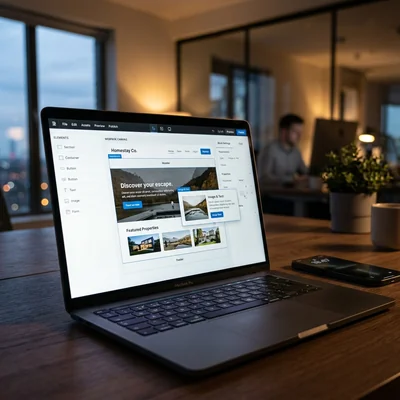
A website builder is a service where you assemble pages from blocks in a visual editor without programming: text, forms, catalog, payments - out of the box. For a business owner it is a fast path to a landing page, business card site, or simple store: Tilda, Nethouse, Wix, Webflow, and dozens of alternatives promise launch in days, not months. But "no code" does not mean "no limits": each platform has its ceiling for SEO, integrations, export, and cost as you grow. Below - who each builder fits, what it costs, when a $10-30/mo plan is enough, and when WordPress, custom development, or at least moving to your own hosting makes more sense.
- Tilda - strong for landing pages and design (Zero Block), popular in CIS; store and CRM with limitations
- Nethouse - simple start for small business in Russia/CIS, domain and hosting "in one window"
- Wix - universal builder with App Market, good for showcase and basic e-commerce
- Webflow - flexible layout and CMS for designers; more capable than typical builders, but harder and pricier
- When a builder is enough - landing, 10-30 pages, leads, catalog up to hundreds of items without complex logic
- When to move on - unique account area, ERP, heavy catalog, strict SEO and speed requirements
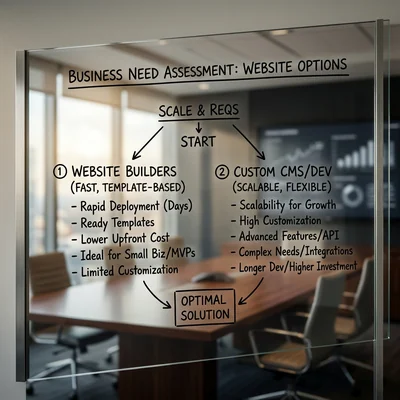
What a Website Builder Is and How It Differs from a CMS
A builder (no-code / low-code platform) hosts your site on its infrastructure: you edit blocks in the browser and publish to a subdomain or custom domain. Page code is generated automatically; server and database access is limited or absent.
A CMS like WordPress - you (or a contractor) install the system on hosting or a VPS, add theme and plugins, and write PHP when needed. More freedom, more responsibility for updates and security.
| Criterion | Builder | WordPress / custom |
|---|---|---|
| Launch time | Days | Weeks to months |
| Developer needed | Rarely at start | Often for integrations |
| Design flexibility | Within the editor | Almost any |
| Export and migration | Hard or impossible | Full control |
| Monthly cost | Plan + domain | Hosting + licenses |
| SEO and speed | Depends on platform | Deeper tuning possible |
For a first site, niche test, or ad campaign, a builder is often rational. For a main sales channel over 3-5 years - assess the platform ceiling upfront.
Tilda: Landing Pages, Zero Block, and the CIS Market
Tilda is one of the best-known builders in Russia and CIS. Strengths:
- Ready blocks - fast landing, portfolio, event pages.
- Zero Block - free layout for those who want "Figma-like" without code.
- Forms, CRM-lite, payments - leads, simple sales, service integrations.
- Templates - start in hours if you do not need a unique brand from scratch.
Weak spots for business:
- Online store - possible, but growth in SKU, complex discounts, and warehouse logic hits platform limits.
- SEO - basic meta, URLs, acceptable speed on good plans; deep technical SEO for owners is not like full control on your own server.
- Platform lock-in - full "export" to another stack is impossible; migration means new layout and manual content move.
Budget guide (2026): free/personal for testing; business plans from roughly $10-20/mo equivalent; domain, mail, paid blocks extra. Contractor "build on Tilda" - $300-1,500 per landing.
Fits: marketing, education, services, events, B2B card site, single product with payment.
Nethouse: Simple Start for Small Business
Nethouse (and similar services) targets small business in Russia/CIS: card site, catalog, simple lead form, often domain and hosting included in subscription.
Pros:
- Low entry barrier - no separate hosting choice.
- Clear admin - owner updates phone, price list, photos.
- Typical templates for salons, construction, healthcare, food service.
Cons:
- Design - noticeably more "template" than Tilda or Webflow.
- Scale - branches, complex catalog, API hit limits quickly.
- SEO and speed - basic level; often not enough for aggressive promotion.
Guide: from roughly $5-10/mo for a simple site; online store costs more. Fits when you need "we have a site" for maps, ads, and trust, not a unique digital product.
Wix: Versatility and App Market
Wix is a global builder with a huge app library (plugin-like): booking, chat, email marketing, basic store.
Strengths:
- Many templates and drag-and-drop editor.
- Wix Stores - e-commerce start without a separate CMS.
- Multilingual and payments in different regions (plan and country dependent).
Limits:
- Performance - heavy pages with many widgets.
- SEO - improved over years, but URL, schema, and server-side logic flexibility below well-tuned WordPress.
- Vendor lock-in - limited export; migration means rebuild.
Guide: free plan with Wix branding; business from ~$17-35/mo; e-commerce higher. Good for showcase, services, small store internationally.
Webflow: Design Without Code, but Already "Semi-Development"
Webflow is for designers and agencies: visual editor close to HTML/CSS layout, plus CMS, hosting, forms, e-commerce.
Pros:
- Layout quality - cleaner than many builders, responsive by default.
- CMS collections - blog, cases, catalog without WordPress.
- Code export (on paid plans) - more freedom than Tilda/Wix.
Cons:
- Learning curve - harder than Tilda and Nethouse; owners often need a contractor.
- Price - from ~$14-39/mo per site; CMS and store cost more.
- Logic - custom flows (complex checkout, ERP) still need JavaScript, integrations, or external backend.
Fits: brands needing unique UI, marketing sites, studio portfolios, content projects with CMS.
Other Options: Squarespace, Readymag, Shopify
| Platform | Focus | When to consider |
|---|---|---|
| Squarespace | Design, blog, showcase | International SMB, creative |
| Readymag | Longread, presentations | Media, cases, lookbook |
| Shopify | E-commerce | Store as core business, not "site with cart" |
| Google Sites | Internal pages | Not for commercial SEO |
| Craftum, Flexbe | CIS Tilda-like | Local market, landings |
Shopify is formally a builder but essentially SaaS store: logical when 80% of the job is sales, not a "pretty card site". Compare with WooCommerce and custom in the WordPress on PHP article.
Builder Comparison for Business
| Criterion | Tilda | Nethouse | Wix | Webflow |
|---|---|---|---|---|
| Ease of start | High | Very high | High | Medium |
| Unique design | Zero Block | Low | Medium | High |
| E-commerce | Basic-medium | Basic | Medium | Medium |
| SEO flexibility | Medium | Below medium | Medium | Above medium |
| Migration | Practically none | Practically none | Limited | Partial (code/CMS) |
| Market | CIS + global | Russia/CIS | Global | Global, agencies |
| Typical budget/mo | $10-30 | $5-15 | $17-40 | $20-50+ |
Figures are guides; exchange rate, plan, and site count change totals.
When a Builder Is Enough vs WordPress or Custom Development
Builder is rational if:
- One product or service - landing for a 3-6 month campaign.
- No in-house IT and development budget under $2,000-3,000.
- Marketer edits content - copy, photos, prices without a developer.
- Standard integrations - form to email, CRM via ready widget, card payment.
- Catalog up to 100-300 items without B2B pricing, warehouses, and ERP API.
Time to look at WordPress, Django, or a dev team if:
- you need an account area with non-standard roles;
- ERP / 1C sync in real time;
- 10,000+ SKU, heavy filters, search (JavaScript and backend load);
- strict speed, audit log, data residency requirements;
- own API for app or marketplace;
- the builder costs more than annual custom support at your traffic.
More on the tipping point in Django/Python development and WordPress migration.
Cost: Plans, Contractors, and Hidden Expenses
| Item | Builder | WordPress turnkey | Custom |
|---|---|---|---|
| Platform/hosting | $10-50/mo | $10-150/mo | $30-300+/mo |
| Initial build | $300-2,000 | $1,000-8,000 | $8,000-50,000+ |
| Support | $0-200/mo | $50-500/mo | $500-5,000+/mo |
| Later migration | New site from scratch | $2,000-15,000 | - |
Hidden builder costs:
- Premium blocks and apps - $5-50/mo each.
- Domain, corporate mail - $10-30/mo.
- Contractor edits - without "real" code access, changes cost more.
- Plan upgrades - second site, team seats, e-commerce often ×2 price.
Rule: calculate 3-year TCO: (plan × 36) + contractor + marketer time. Sometimes $25/mo × 3 years = $900 beats one-time WordPress at $3,000 - fine for MVP.
SEO, Speed, and Mobile
A builder does not kill SEO automatically, but does not guarantee top rankings either:
- check URLs, title/description, H1-H2;
- connect Google Search Console and analytics;
- compress images - large photo blocks often slow pages most;
- on mobile test forms and buttons - half of leads come from phones.
On WordPress or your own VPS you can tune cache, CDN, schema deeper - but only if someone administers it. Builders win when there is no admin and SEO means "basic hygiene + content".
Builder Selection Checklist
- Site goal - leads, sales, brand, knowledge base?
- Lifetime - quarter campaign or 5-year asset?
- Who edits content - you, marketer, contractor?
- Store needed? - how many SKU, payment, shipping, returns?
- Integrations - CRM, ERP, telephony, email - ready widget?
- SEO - local business or national/international competition?
- Plan B - if the plan gets expensive or features fall short?
- 3-year budget - plan + edits + your time.
If answer to 7 is "nothing, we stay locked in" - assess HTML structure and content so WordPress or custom migration does not start with losing all copy.
Summary
Builders (Tilda, Nethouse, Wix, Webflow, and peers) are the right tool for fast start, landings, card sites, and simple e-commerce without an IT department. Tilda and Webflow - design; Nethouse - simplicity in CIS; Wix - versatility; Shopify - store as product.
Owners should:
- pick a platform for 12-24 month goals, not "forever";
- plan Plan B (content export, domain in your name);
- not confuse pretty blocks with business logic - the latter hits ceilings fast;
- when growing, compare builder TCO with WordPress or custom development, not just today's plan price.
A good builder is invisible - leads flow, ads pay off, you change the promo yourself on Friday evening. A bad one - after a year you pay three subscriptions, the catalog filter "still can't do that", and migration costs like a new site.
If you need help with development, AI implementation, or website support for your project - contact me.
Frequently Asked Questions
Can I build a full online store on Tilda or Wix?
Yes, for a small store - roughly 100-500 SKU, standard payment and shipping, without complex B2B pricing and ERP warehouse sync. Tilda and Wix cover showcase + cart + payment. Full e-commerce with real-time stock, wholesale prices, and 1C integration is WooCommerce, Shopify, or custom territory - otherwise within a year the site runs on workarounds and manual price updates.
Can I move from a builder to WordPress or my own hosting?
Content - partly, platform - no. Copy, images, and section structure usually move manually or via export where available (Webflow CMS better than Tilda/Wix). Design and blocks do not "move" - WordPress or Django is rebuilt. Budget $2,000-10,000 and 4-12 weeks for a medium site migration. Keep the domain on your registrar account - platform changes are easier.
Which builder is best for SEO?
There is no single "best for everyone." Webflow and Tilda on higher plans give more control over meta, headings, and speed than Nethouse. Wix closed many SEO gaps but flexibility is below tuned WordPress. For local business (maps, reviews, NAP) any builder works with decent content. For competitive niches, content, links, and technical SEO matter more - often WordPress or custom with SEO audit beats an expensive builder plan "for SEO".
How is Webflow different from Tilda and when is it worth it?
Webflow is closer to professional layout: clean CSS, CMS collections, code export on some plans. Tilda is faster for a marketing landing without training. Webflow pays off with a designer/agency, unique UI, content site, or brand portfolio. For "dentist site over the weekend" Tilda or Nethouse is usually cheaper and simpler; Webflow pays off in aesthetics and content scale, not speed to "publish".
Nethouse or Tilda for small business in Russia?
Nethouse if you need the simplest card site, price list, contacts, map, minimal budget, and you update the phone twice a year yourself. Tilda if presentation, ad landings, Zero Block, payment integrations, and a more modern look matter. For aggressive performance marketing Tilda is more common; for "site on the business card" - Nethouse. If you plan store or growth in 1-2 years - compare e-commerce plans and limits upfront, or migration is inevitable.
Terms in this article
Tilda — block-based website and landing page builder
Webflow — visual website builder with hosting and CMS
landing pages — pages built for conversion goals
Zero Block — Tilda freeform block editor for custom layouts
e-commerce — online selling of goods or services
CRM — Customer Relationship Management
app market — marketplace of apps/extensions
CMS — Content Management System
ERP — Enterprise Resource Planning
VPS — Virtual Private Server
lock-in — hard to leave a vendor or stack without costly rewrite
SKU — Stock Keeping Unit
B2B — Business to Business
vendor lock-in — hard to leave a vendor without costly rewrite
server-side — logic that runs on the server, not in the browser
backend — server-side logic, APIs and data layer
SMB — Small and Medium Business
SaaS — Software as a Service
in-house — done by the company's own team
data residency — requirement to keep data in a specific country/region
widget — embedded UI component
audit log — chronologically recorded trail of who did what
knowledge base — structured repository of answers/docs
TCO — Total Cost of Ownership
MVP — Minimum Viable Product
CDN — Content Delivery Network
real-time — processed with minimal delay