Tilda vs WordPress vs Django Site: What a Business Owner Should Choose
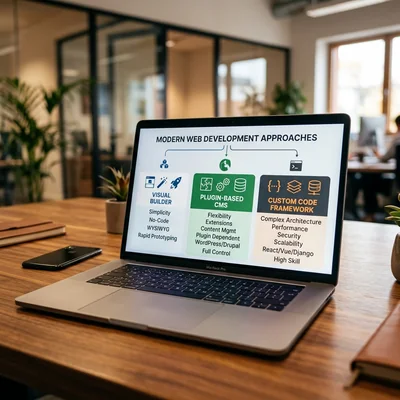
Tilda, WordPress, and a Django site are three different answers to one question: "how do I build a website for my business?" Tilda is a cloud website builder: pages from blocks, hosting included, launch in days. WordPress is a PHP CMS on your or managed hosting: themes, plugins, WooCommerce for stores. Django is custom development in Python: unique logic, APIs, customer portals, full control over code. For a business owner, the choice is not "what is trendier" but timeline, budget, flexibility, and who will maintain the site in 2-3 years. Below - who each option fits, real costs, typical mistakes, and a simple decision framework.
- Tilda - landing, business card site, promos; from ~$5-15/mo; no developer at start
- WordPress - blog, corporate site, store up to thousands of SKUs (stock keeping units); hosting + plugins from $10-80/mo
- Django - custom logic, portals, integrations, API; development from $5,000-50,000+
- Fast launch - Tilda (1-7 days), WordPress (2-6 weeks), Django (1-4+ months)
- Main Tilda risk - platform ceiling and hard migration
- Main WordPress risk - plugins, security, rising TCO (total cost of ownership) at scale
- Main Django plus - you own the code; minus - team and budget needed upfront
Three Approaches - The Essence in 2 Minutes
| Criterion | Tilda | WordPress | Django |
|---|---|---|---|
| Type | SaaS builder | CMS (open source) | Framework + development |
| Code | Closed, in Tilda cloud | PHP, themes, plugins | Python, your repository |
| Hosting | Included | Separate ($5-50+/mo) | Separate (VPS/cloud) |
| Start without developer | Yes | Yes, with plugins | No |
| Flexibility | Medium, platform limits | High with PHP | Maximum |
| E-commerce | Basic catalog, CRM | WooCommerce | Custom / Oscar |
| SEO | Good for landings | Flexible with plugins | Full control |
| Migration | Hard | Easier (own server) | Not needed (you own it) |
| 3-year TCO (small business) | $500-3,000 | $1,500-8,000 | $8,000-40,000+ |
Rule of thumb: if the site is a showcase and lead capture, look at Tilda. If content + store + multi-year growth - WordPress. If the site is the core of business processes (portal, API, ERP) - Django.
Tilda: When It Is the Best Choice
Tilda is a builder with a strong visual editor and Zero Block for precise layout without code. Popular for landings, product pages, courses, and event sites.
Who Tilda Fits
- Ad landing - one or several pages, lead form, analytics, block-level A/B.
- Service business card - lawyer, clinic, studio: 5-15 pages, portfolio, basic blog.
- Promos and events - conference, campaign, product pre-launch for 1-3 months.
- Design-sensitive projects - when typography and animation matter without a frontend budget.
- Fast MVP - test demand before investing in custom development.
How Much Tilda Costs
| Item | Estimate | Comment |
|---|---|---|
| Personal plan | ~$5-10/mo | 1 site, basic features |
| Business plan | ~$15-25/mo | Multiple sites, catalog, CRM-lite |
| Domain | $10-20/year | Own domain or transfer |
| Zero Block / design | $0-2,000 | DIY or contractor |
| Integrations | $0-100/mo | Email, CRM, payments via third parties |
| SEO audit | $700-2,500 | If organic is the main channel |
Typical landing launch time: 3-14 days with ready copy and visuals.
Tilda Limitations
- Complex e-commerce - many variants, B2B pricing, warehouses, ERP - you hit the ceiling fast; consider Shopify or WooCommerce.
- Unique logic - subscriptions, multi-parameter calculators, role-based portals - not for a builder.
- SEO at scale - thousands of URLs, aggressive internal linking, fine HTML control - WordPress or Django offer more.
- Vendor lock-in - export is limited; moving to another stack means rebuilding design and content. More on builders in general.
WordPress: When a CMS with Plugins Is Enough
WordPress is the most common CMS: installed on hosting, styled with a theme, extended with plugins. For business it balances launch speed and flexibility without full custom development.
Who WordPress Fits
- Corporate site and blog - 20-200 pages, news, case studies, multilingual (WPML/Polylang).
- Mid-size online store - WooCommerce, up to several thousand SKUs, standard payment and shipping.
- Content marketing - SEO, editorial calendar, email integration.
- Multi-year site with budget for hosting and periodic PHP support.
- Gradual growth - landing on a theme first, then store, then integrations via plugins.
How Much WordPress Costs
| Item | Estimate | Comment |
|---|---|---|
| Hosting | $5-50/mo | Shared VPS or managed WordPress |
| Domain | $10-20/year | |
| Theme | $0-100 one-time | Premium themes $50-100 |
| Plugins | $0-50/mo total | SEO, cache, forms, backups, WooCommerce extensions |
| Contractor setup | $700-3,000 | Theme, basic SEO, forms |
| PHP support | $50-120/hour | Updates, tweaks, security |
Annual TCO (small site): hosting ($120) + theme ($80) + plugins ($200) + setup ($1,200) = ~$1,600/year without heavy customization.
More on the "plugins vs developer" line - in WordPress on PHP.
WordPress Limitations
- Plugin zoo - 25 extensions conflict, slow the site, break after updates.
- Security - vulnerabilities in themes and plugins; updates and monitoring required.
- Complex business logic - marketplace, multi-step B2B orders, custom checkout - hits PHP development or migration to Django.
- Performance - without cache and CSS/JS optimization, heavy WooCommerce hurts Core Web Vitals (Google's page speed and stability metrics).
Django: When You Need Custom Development
Django is a Python web framework: admin, ORM (database layer), security, API out of the box. A Django site is not a "template in the browser" but a project for your processes: logic, integrations, and data designed from scratch.
Who Django Fits
- Customer portal - clients, partners, staff with different roles and permissions.
- Complex catalog and orders - non-standard pricing, warehouses, B2B, subscriptions, configurators.
- Integrations - ERP, CRM, payment and logistics APIs in real time.
- Marketplace and SaaS - multiple user types, billing, API for mobile app.
- Data requirements - storage in a specific jurisdiction, audit, custom analytics.
- Long horizon - site as a product for 5-10 years, not a builder showcase.
How Much a Django Site Costs
| Project type | Budget | Timeline |
|---|---|---|
| Landing + forms + admin | $5,000-12,000 | 4-8 weeks |
| Corporate site with portal | $12,000-30,000 | 2-4 months |
| E-commerce with custom logic | $20,000-60,000+ | 3-6 months |
| Marketplace / SaaS MVP | $40,000-150,000+ | 4-9 months |
| Hosting and support | $50-500+/mo | VPS, monitoring, changes |
Detailed breakdown - in Django/Python development.
When Django Is Overkill
- You need a one-page landing for a month-long ad campaign - Tilda is faster and cheaper.
- A typical store without unique logic - WooCommerce covers it for a fraction of the budget.
- No support budget - custom code needs a developer or contractor ongoing.
- The team wants to edit everything without code - Django content often goes through admin, but page structure is less drag-and-drop than Tilda.
Comparison by Business Task
| Task | Best start | Why |
|---|---|---|
| Service landing | Tilda | Speed, design, low entry barrier |
| Blog + SEO for years | WordPress | Ecosystem, content flexibility |
| Store up to 500 SKUs | WordPress + WooCommerce | Plugins, familiar contractors |
| Store with ERP and B2B | Django | Custom logic and API |
| Customer portal | Django | Role-based access (RBAC), integrations |
| MVP in 2 weeks | Tilda | No development |
| MVP with unique logic | Django | Architecture from day one |
| Migration from builder | WordPress or Django | Depends on catalog and portal complexity |
Decision Framework in 5 Questions
Answer honestly - it saves months and thousands of dollars:
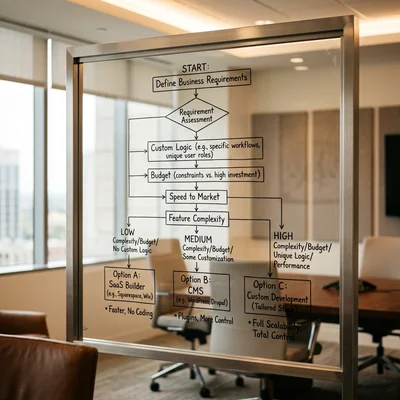
- Is the site a showcase or the operating system of the business? Showcase - Tilda/WordPress. OS - Django.
- Do you need a role-based portal? No - Tilda/WordPress. Yes - almost always Django (or heavy WP customization).
- How many SKUs and how complex is pricing? Up to 500 standard - WooCommerce. Hundreds of rules - Django.
- Who will maintain it in 2 years? Marketer - Tilda. Content manager + contractor - WordPress. Dev team - Django.
- One-time launch budget? Up to $1,000 - Tilda. $1,000-5,000 - WordPress. $5,000+ - plan Django.
If 2-3 answers point to Django, do not "save" on Tilda with a plan to "rebuild later" - migration costs more than a proper MVP upfront.
Typical Business Owner Mistakes
"Tilda first, then move to WordPress"
Works for a simple landing without a catalog. Fails if you already run a store, CRM, and hundreds of pages on Tilda - migration eats a budget comparable to a proper WordPress start.
"WordPress is free - so it is cheap"
The engine is open source, but hosting, premium plugins, security, PHP tweaks are ongoing. At traffic and revenue scale, WordPress TCO can catch up with managed platforms.
"Django is for everyone serious"
Django pays off with unique logic. A 15-page corporate site on Django is 3-5x overpay vs a solid WordPress setup.
Ignoring SEO and speed at launch
Tilda gives beautiful blocks, but as organic grows, compare with an SEO audit. WordPress without cache loses. Django without DevOps (server setup and maintenance) can be slow too.
Summary
Tilda is the best choice for a fast landing and business card without a developer: low barrier, strong design, predictable subscription. WordPress is the middle ground for content, blog, and a typical store with room to grow via plugins and PHP. Django is the path when the site is part of the product: portal, API, integrations, non-standard logic, full code ownership.
Before signing an annual contract on any platform, ask: "What will change in the business in 18 months?" If the answer is ERP, marketplace, and customer portals, do not plan eternal life on Tilda. If the answer is "10 more pages and a blog", Django will be overkill.
Current guides on service pricing - on the pricing page.
If you need help with development, AI implementation, or website support for your project - contact me.
Frequently Asked Questions
Can I start with Tilda and later move to WordPress?
Yes, for a simple landing - copy and structure move manually in 1-3 weeks. Hard if Tilda already has a store, CRM, hundreds of products, and custom integrations: design is rebuilt, URLs change with 301 redirects, SEO dips temporarily. Plan migration before accumulating "technical debt" on the builder.
Is WordPress cheaper than Django long term?
Often yes for typical tasks - landing, blog, store up to 1,000 SKUs without unique logic. WordPress: hosting + plugins $1,500-5,000/year. Django: $10,000-30,000+ one-time development, but with complex integrations endless WordPress tweaks can exceed one solid Django project. Calculate 3-year TCO, not just launch cost.
When is Tilda definitely not suitable?
When you need a complex B2B portal, ERP/1C sync, marketplace, thousands of SEO pages with fine URL control, custom checkout, or data stored only on your servers. In those cases Tilda is a temporary crutch, not a multi-year platform.
Do I need a developer for WordPress?
Not required at start: theme, plugins, content in admin. A developer is needed when plugins do not cover logic, speed drops, custom integrations are required, or secure WooCommerce at high traffic. The "one more plugin vs PHP" line - in WordPress on PHP.
How much does a Django site cost for a small business?
Minimum custom project (landing, forms, admin, basic portal) - $5,000-12,000, 4-8 weeks. Corporate site with integrations - $12,000-30,000. Below $5,000 on Django usually means cut scope or freelance without tests and support. Detailed ranges — see Django project cost.
Terms in this article
Tilda — block-based website and landing page builder
CMS — Content Management System
open source — software with publicly available source code
SaaS — Software as a Service
VPS — Virtual Private Server
e-commerce — online selling of goods or services
CRM — Customer Relationship Management
Zero Block — Tilda freeform block editor for custom layouts
frontend — client-side UI of a site or app
MVP — Minimum Viable Product
DIY — Do It Yourself
vendor lock-in — hard to leave a vendor without costly rewrite
ERP — Enterprise Resource Planning
B2B — Business to Business
plugin — installable extension module
Core Web Vitals — Google metrics for loading, interactivity, and visual stability
ORM — Object-Relational Mapping
RBAC — Role-Based Access Control
DevOps — Development and Operations
technical debt — shortcuts in code that cost extra work later