WordPress, Laravel, or Django - What Should Business Choose in 2026?
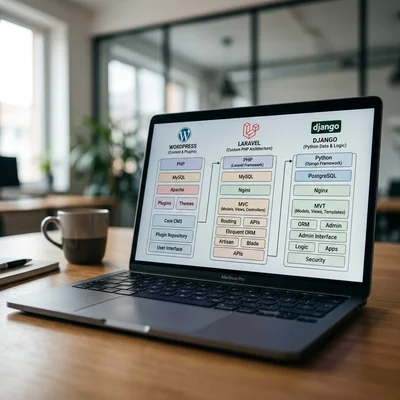
You need a site, a customer portal, or an internal service - and the vendor proposes WordPress, Laravel, or Django. These are not “three CMS options,” but three different classes of solutions: a ready CMS on PHP, a PHP framework for custom apps, and a Python framework for complex logic and APIs. In 2026 a wrong stack usually hurts TCO and change turnaround, not “fashion.” Below - how to pick a stack for the business job, without hype and without locking to a developer’s favorite language.
- WordPress - content, blog, corporate site, typical store; fast start, wide ecosystem
- Laravel - custom PHP product: portal, billing, roles, API, integrations without a “plugin zoo”
- Django - complex business logic, data, background jobs, AI/analytics on Python
- Budget ballpark - WP from $1 500; Laravel/Django from $8 000 - 15 000+ for a meaningful product
- Main criterion - not the language, but unique logic volume and who will maintain it in 2-3 years
Three stacks - the difference in one sentence
| Stack | What it is | Strength | Weakness |
|---|---|---|---|
| WordPress | CMS on PHP | Speed for content and typical sites | Plugins, security, custom ceiling |
| Laravel | PHP framework | Clean product architecture on PHP | Needs a team; no out-of-the-box admin like WP |
| Django | Python framework | Logic, data, API, Python ecosystem | More expensive content-edit support |
WordPress - you buy (and extend) a content management system. Laravel and Django - you design an application around business processes. Comparing them by “admin beauty” is pointless: for WP the admin is the product; for frameworks it is a development result.
More on CMS vs custom boundaries - in Tilda vs WordPress vs Django and in WordPress vs Laravel for a PHP developer.
When to choose WordPress
WordPress fits when:
- you need a corporate site, blog, landings, news, media;
- editors must change pages without a developer;
- the store is typical (WooCommerce), without hard B2B price/stock rules;
- you care about 2-6 week timelines and a clear vendor pool;
- launch budget is limited, and SEO plus content is the main channel.
Typical TCO 2026: hosting / managed WP $10-80/mo, plugins $0-100/mo, support $200-800/mo. One-off brochure / corporate site - often $1 500 - $8 000; a heavier store - $5 000 - $25 000+.
Risks: plugin zoo, updates, nulled-theme hacks, “everything on a page builder.” Fix with discipline: few plugins, child theme, backups, updates, do not put critical logic only in a visual builder.
WordPress is not ideal if you need a complex customer portal, non-standard billing, partner API, or heavy calculations. Then Laravel/Django - or a hybrid (marketing on WP + app separately).
When to choose Laravel
Laravel is a sound choice when:
- the product is an application, not “a site with text”;
- you need roles, queues, API, payments, multi-tenancy;
- the team is already strong in PHP (agencies, ex-Bitrix/WP teams);
- you want clean code without CMS-core and plugin-market dependency;
- you plan 2-3 years of feature growth without a platform swap.
Laravel gives Eloquent, queues, events, Passport/Sanctum, package ecosystem - a product skeleton, not a ready site. Admin (Filament, Nova, etc.) and front you assemble yourself or with a UI kit.
Budget ballpark: MVP / portal / B2B portal - often $10 000 - $40 000+, timelines 2-4+ months. Support is cheaper than a “WP zoo” on hard jobs, but more expensive than WordPress for text and landing edits.
When Laravel beats Django: PHP vendor pool is wider/cheaper in some markets; stack sits closer to existing WordPress/Bitrix landscape; PHP hosting is simpler for some teams. When it loses: if the product core is data, ML, scraping, heavy analytics on Python - Django/Python services are usually more natural.
Laravel is not a fit if the site is mostly content and landing pages without complex logic: you would overpay for an application skeleton you never use, and routine text edits will cost more than on WordPress.
When to choose Django
Pick Django if:
- there is a lot of custom business logic and complex data models;
- you need API, background jobs, integrations, reports, enterprise-level permissions;
- Python is already nearby: bots, parsers, CRM automation, AI layer;
- you care about code predictability and tests, not a plugin marketplace;
- the site is only a storefront - value lives in the backend system.
Django Admin / Wagtail cover some editorial work, but for a marketing team it is still not WordPress. Often it is better to keep content on WP and logic on Django (see migration both ways and WP → Django).
Django is not a fit if you just need a content site or blog for marketing: development and text edits will cost more, and there is no WordPress-level “admin for a content manager” here.
Ballpark: custom product $12 000 - $50 000+, timelines 2-6+ months. TCO rises with Python developer rates; on complex logic you avoid the “plugin tax” and rewrites.
Comparison for a business owner (2026)
| Question | WordPress | Laravel | Django |
|---|---|---|---|
| Storefront launch speed | High | Medium | Medium / lower |
| Content edits without a developer | Excellent | Weak without a CMS layer | Medium (Admin/Wagtail) |
| Custom logic and roles | Limited | Strong | Strong |
| API and mobile client | Via plugins / REST | Native | Native (DRF) |
| Store “out of the box” | WooCommerce | Custom / packages | Custom / Oscar etc. |
| Vendor pool | Very wide | Wide (PHP) | Narrower, but stable |
| Typical risk | Security and plugins | Underestimated scope | Expensive content support |
| Hosting | Shared / managed / VPS | VPS / cloud | VPS / cloud |
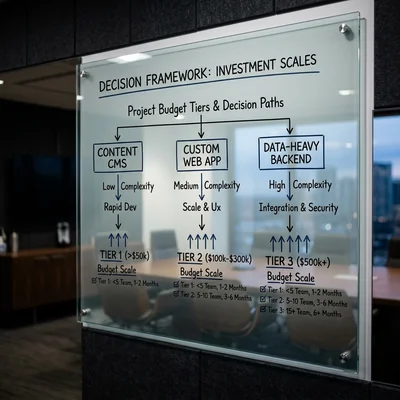
A simple decision scheme
- Site = content + forms + SEO → WordPress (or even a site builder if very simple).
- Need a product on a PHP team (portal, billing, API) → Laravel.
- Core value in data / Python / AI / complex processes → Django.
- Marketing separate, product separate → WordPress + Laravel or WordPress + Django.
- Not sure → 2-5 days of requirements audit: must-have logic vs content list. Audit is cheaper than a stack swap in a year.
Common mistake in 2025-2026: building a complex product on WordPress “because we know it” or ordering Django for a brochure site “for growth.” Both burn budget.
Budget and timelines - rough ranges
| Project type | WordPress | Laravel | Django |
|---|---|---|---|
| Corporate site / blog | $1 500 - $8 000, 2-6 wks | $8 000 - $20 000, 1-3 mo | $10 000 - $25 000, 1.5-3 mo |
| Store / catalog | $5 000 - $25 000 | $15 000 - $50 000+ | $15 000 - $50 000+ |
| Portal + API + roles | Usually a poor fit | $15 000 - $60 000+ | $15 000 - $60 000+ |
| Support / month | $200 - $800 | $800 - $3 000+ | $1 000 - $4 000+ |
Figures are a guide for Eastern Europe / CIS teams in 2026; brand agencies and enterprise vendors will be higher.
Bottom line
WordPress, Laravel, or Django in 2026 is chosen not by programming language, but by product type:
- WordPress - if content, speed, and cheap editorial support win;
- Laravel - if you need a custom PHP product with API and roles without CMS tax;
- Django - if the core is complex logic, data, and the Python ecosystem.
Mixing stacks is fine: marketing on WordPress, portal on Laravel or Django. The key is to lock scope before the contract and not buy a “universal platform” that does not exist.
Need help choosing a stack for your brief - contact me, we can sort it out in 1-2 calls.
Frequently Asked Questions
How is Laravel different from WordPress for business?
WordPress is a ready CMS: pages, posts, plugins, admin out of the box. Laravel is a framework: you build an application (portal, billing, API) from scratch or on packages, without CMS-core dependency. For a blog and corporate site WP is almost always faster and cheaper. For a product with complex roles Laravel is usually cleaner and more predictable than “WP + 20 plugins.”
Can we start on WordPress and later move to Laravel or Django?
Yes, that is a common path. First you validate demand on a content site, then move the portal and logic to a framework. Plan clean URLs, a sane data structure, and do not put critical billing only in plugins - otherwise migration will cost more than the start. A hybrid “WP for marketing + API on Laravel/Django” is often better than a full rewrite.
What is cheaper to maintain over 2-3 years?
A content site - almost always WordPress. A logic-heavy product - Laravel or Django: you pay a developer, but not constant plugin hacks and update conflicts. Calculate TCO: support rate + hosting + cost of a typical change + downtime risk. A cheap WP start on a complex brief is often the most expensive scenario.
Laravel or Django - which to pick if both fit?
Look at the team and ecosystem around the product. You already have a PHP agency and PHP-world integrations - Laravel. Bots, scraping, data/ML, internal analytics on Python are nearby - Django. Both can handle portal, API, and queues; the difference is more often hiring and neighboring services than “language speed.”
Do we need VPS and DevOps from day one for any of the three?
For WordPress managed hosting or solid shared often enough at the start. For Laravel and Django a sensible minimum is VPS or PaaS with CI/CD, backups, and staging. Full DevOps “from scratch” is not mandatory for an MVP, but without staging and backups you save on infrastructure and overpay on incidents.
Terms in this article
CMS — Content Management System
TCO — Total Cost of Ownership
plugin — installable extension module
Tilda — block-based website and landing page builder
B2B — Business to Business
page builder — visual editor that builds pages from blocks
child theme — WordPress theme that safely overrides a parent theme
Eloquent — Laravel ORM for database access
MVP — Minimum Viable Product
landing pages — pages built for conversion goals
ML — Machine Learning
storefront — customer-facing shop UI
CRM — Customer Relationship Management
backend — server-side logic, APIs and data layer
Wagtail — Django CMS for editors and content teams
must-have — required capability or requirement
VPS — Virtual Private Server
downtime — period when the service is unavailable
staging — pre-production environment for final checks
CI/CD — Continuous Integration / Continuous Delivery
DevOps — Development and Operations
PaaS — Platform as a Service