Migrating from Django to WordPress - When It Makes Sense and What It Costs

Django on Python is a strong choice for custom business logic, APIs, and complex roles. But sometimes the product has “shrunk” to content and forms, and keeping a Python backend team costs more than the framework’s benefits. Then a migration to WordPress (more precisely - moving from Django to WordPress/PHP) can lower TCO (total cost of ownership) and speed up editorial work. Below - when it is justified, when it is not, and typical budgets and timelines in 2026.
- Typical reasons - Django became overkill: the site is content + blog + forms without complex logic
- Migration budget - $1 500 - $25 000+ depending on data volume, design, and SEO
- Timelines - 2-6 weeks for a typical corporate site, 2-4 months with a catalog and customer portal
- Savings - easier to find a WordPress vendor, cheaper to maintain editorial content
- Main risk - losing needed business logic and SEO if you cut features by guesswork
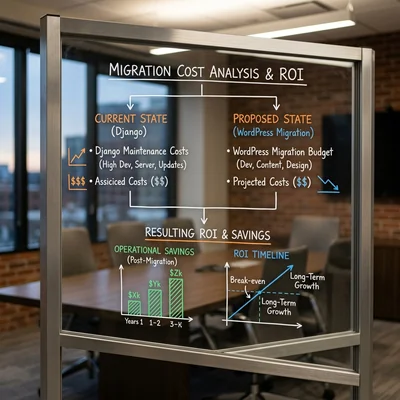
When Django Starts Holding the Business Back
Django is not “outdated” - it is more expensive to maintain when you no longer use its strengths:
- No custom logic - no complex roles, partner APIs, background jobs, or calculations;
- Editors struggle in Django Admin / Wagtail: content changes go through a developer;
- Hiring is expensive for a Python developer on small template and form tweaks;
- Hosting and deploy are heavier than shared / managed WordPress or a plain VPS with PHP;
- The product was simplified - you dropped the portal, billing, and marketplace; what remains is a marketing site.
WordPress wins here not by “fashion,” but by speed of content work and a broad ecosystem of themes and plugins.
When a Migration to WordPress Makes Sense
| Situation | Why WP fits | What to check first |
|---|---|---|
| Corporate site / blog | The editorial team manages pages and news itself | No hidden logic in Django models |
| Landing pages and content marketing | Fast edits without a release | Forms and CRM webhooks can be replaced with plugins |
| No API and no mobile client | WP covers the full HTML site | No external integrations tied to DRF (Django REST Framework) |
| Support budget is being cut | A PHP vendor / agency is cheaper | WP TCO with plugins is truly lower than Django |
| The team left Python | No owner for the Django code | Ready to lock scope: what you will not migrate |
If the site is essentially a CMS + forms + marketing pages, a move to WordPress often pays back in 6-18 months through a lower support rate.
When It Is Better to Stay on Django
Migration does not make sense if:
- you have a customer portal, subscriptions, billing, complex roles, and approval flows;
- APIs, a partner portal, or a mobile app on the same backend matter;
- e-commerce or a B2B catalog with non-standard pricing / stock rules;
- integrations with 1C, CRM, or warehouse systems are written in Python and work stably;
- Django Admin is already tuned to your processes and editors use it.
In those cases it is cheaper to simplify Django (Wagtail, permissions, templates) than to rewrite logic as WordPress plugins.
What a Django → WordPress Migration Includes
- Django project audit - models, views, API, templates, media, cron/Celery, integrations.
- Scope decision - what moves to WP, what is turned off, what stays as a separate service.
- Design and theme - a custom theme or a customized stock theme; adapting the current layout.
- Content migration - pages, posts, media, meta, categories; scripts from the Django DB / fixtures.
- Forms and leads - replace Django forms with plugins + webhooks to CRM / Telegram / email.
- Users - if accounts are needed: import, WP roles, password policy.
- SEO layer - 301s from Django URLs to new ones, sitemap, canonical, meta tags.
- Hosting and deploy - shared, managed WP, or a VPS with nginx + PHP-FPM + MySQL/MariaDB.
- Editorial training - Gutenberg / classic editor, menus, drafts, media library.
Important: do not try to recreate all of Django in WordPress. The goal is a simpler product for real 2026 needs.
Migration Strategies
Big bang
Old Django is turned off, WordPress is turned on in a maintenance window.
- Pros - one cutover, no dual support.
- Cons - higher risk for SEO and lead forms.
- When it fits - small site, few URLs, low traffic off-peak.
Phased
First move the blog or marketing pages to WP behind a reverse proxy; Django temporarily still serves the portal/API.
- Pros - lower risk, you can roll back a piece.
- Cons - two systems; shared auth is harder.
- When it fits - high traffic; you cannot pause lead intake.
Headless / hybrid
WordPress is CMS only; part of the front end or old URLs stay on static / a separate front.
- Pros - flexibility for marketing.
- Cons - more complex architecture; for small business often overkill.
For most corporate sites, big bang after two dry-run content migrations is enough.
Migration Cost
Price depends on content volume, Django code quality, whether you need a redesign, and the redirect map - not on “moving to WordPress” as a slogan.
Typical ranges (USD, Eastern Europe / CIS outsourcing)
| Scenario | What is migrated | Budget | Timeline |
|---|---|---|---|
| Landing / brochure site | 5-20 pages, forms, basic SEO | $1 500 - $4 000 | 2-3 weeks |
| Corporate site + blog | 20-100 pages, media, menus, forms | $3 000 - $10 000 | 3-6 weeks |
| Content + catalog without complex logic | Up to 1 000 items, filters via plugins | $8 000 - $18 000 | 6-10 weeks |
| Complex legacy Django | Many models, custom templates, integrations | $15 000 - $25 000+ | 2-4 months |
For US / Western European teams - multiply by x2-x3. A redesign “from scratch” adds +20-40% to the budget.
What the Budget Is Made Of
| Item | Share | Comment |
|---|---|---|
| Django audit and brief | 10-15% | Cuts excess scope and hidden logic |
| Theme / frontend | 25-40% | A stock theme is cheaper than custom markup |
| Content migration | 15-25% | Scripts, media, validation, dry-run |
| Plugins and forms | 10-15% | SEO, forms, cache, security, multilingual |
| SEO and redirects | 5-10% | URL map, 301s, Search Console checks |
| Hosting, SSL, deploy | 5-10% | DNS migration, backups, staging |
| Testing and training | 10-15% | UAT with editors, cutover checklist |
It is risky to skimp on the audit and SEO: otherwise after launch you discover that a “simple brochure site” carried hidden price logic or unique URLs with no redirects.
Timelines and Critical Path
| Stage | Brochure | Corporate | Legacy Django |
|---|---|---|---|
| Audit, page map | 1-3 days | 3-5 days | 1-2 weeks |
| Theme and layout | 3-7 days | 1-3 weeks | 2-4 weeks |
| Content migration | 2-4 days | 1-2 weeks | 2-3 weeks |
| Forms, plugins, integrations | 2-3 days | 3-7 days | 1-3 weeks |
| SEO, redirects, UAT | 2-3 days | 3-5 days | 1-2 weeks |
| Cutover | a few hours | 1 day | 1-2 days |
| Total | 2-3 weeks | 3-6 weeks | 2-4 months |
Timelines grow because of messy media, duplicate slugs, custom templates without docs, and slow menu/redesign alignment with marketing.
Savings and Payback
When Savings Are Real
- a PHP/WordPress specialist rate is lower than a Python fullstack for small edits;
- editors change copy without tickets to engineering;
- it is easier to replace a vendor;
- managed WordPress / a plain VPS is enough instead of a heavy Django+Celery+PostgreSQL stack.
A Simple Estimate Example
Payback (months) = migration cost / (monthly support savings)
Example: corporate site migration for $6 000. Django support was $800/mo, WordPress retainer - $300/mo. Savings $500/mo → payback ~12 months (not counting content marketing speed).
The migration does not pay back if in six months you need a portal, API, and custom billing again - you will pay for the move twice (there and back).
Risks and How to Reduce Them
SEO loss. Full 301 map before cutover, keep slugs where possible, monitor 404s for the first 4-8 weeks.
Feature loss. Lock a “must have” / “do not migrate” list in the brief; do not promise WooCommerce where you had complex B2B pricing on Django.
WP security. Minimal plugins, updates, WAF/basic hardening, no nulled themes.
Vendor lock on a page builder. Do not build the whole site only on a heavy page builder without an export plan.
Content chaos. Before import, clean drafts, duplicates, and broken media in Django.
Django vs WordPress for a “Simplified” Product
| Criterion | Django | WordPress |
|---|---|---|
| Custom business logic | Strength | Plugins and workarounds |
| Speed of content edits | Often via a developer | Editors themselves |
| API / Python integrations | Convenient | Via plugins / webhooks |
| Vendor pool | Narrower | Wider and cheaper for typical tasks |
| TCO for a simple site | Often inflated | Usually lower |
| TCO as logic grows | More predictable | Grows in jumps |
Bottom Line
Migrating from Django to WordPress makes sense when the project stopped being an application and became a content site: blog, pages, forms, marketing. Budget - from $1 500 for a brochure site to $25 000+ for complex legacy; timelines - from 2 weeks to 4 months. Payback - more often 6-18 months through cheaper support.
If business logic, APIs, or a portal are still critical - stay on Django or move only marketing to WordPress. Start with a 2-5 day audit: it will show whether the move pays off or it is cheaper to simplify the current stack.
If you need help with development, AI implementation, or website support for your project - contact me.
Frequently Asked Questions
When is a Django-to-WordPress migration truly justified?
When the site is mostly content and forms, there is no complex portal/API, and the team spends budget on Python support without benefit from the framework. If editors wait on a developer for every text change - WordPress usually delivers a quick win. If Django still covers billing, roles, and integrations - the move will almost certainly cost more than supporting the current code.
How much does a typical corporate site migration cost?
For a site with 20-100 pages, a blog, media, and forms, the ballpark is $3 000 - $10 000 and 3-6 weeks with Eastern Europe / CIS teams. Price grows with a redesign, multilingual setup, a large media library, and strict SEO requirements. A legacy audit for $300 - $800 before the contract often saves more than it costs.
Will we lose search rankings after changing CMS?
Not necessarily - with a 301 redirect map, slugs kept where possible, title/description migration, and Search Console monitoring. The risk is not WordPress itself, but “we moved and forgot about URLs.” Budget 5-10% for the SEO layer and the first weeks after cutover.
Can we keep the Django API and put only the front / marketing on WordPress?
Yes. A common hybrid: WordPress serves landings and the blog, Django serves the API or portal on a separate subdomain / path. You need aligned cookies/SSO or separate accounts and a careful reverse proxy. Downside - two systems to support; upside - you do not break working business logic for editorial convenience.
What is cheaper long term: simplify Django or move to WordPress?
Simplifying Django is cheaper if the logic is still needed (cut modules, improve Wagtail/Admin, shrink infrastructure). WordPress is cheaper if the product has stably become a marketing site and you are ready to live in a themes/plugins model. Calculate TCO over 12-24 months: support rate + hosting + cost of typical edits + risk of migrating back again.
Terms in this article
backend — server-side logic, APIs and data layer
Wagtail — Django CMS for editors and content teams
VPS — Virtual Private Server
landing pages — pages built for conversion goals
webhooks — HTTP callbacks when events happen
CRM — Customer Relationship Management
CMS — Content Management System
e-commerce — online selling of goods or services
B2B — Business to Business
Celery — Python task queue for background jobs
PHP-FPM — PHP FastCGI Process Manager for serving PHP apps
reverse proxy — front server that routes requests to backends
cutover — moment when traffic switches to the new system
big bang — one-shot cutover to the new system at a single moment
dry-run — rehearsal migration without switching production
frontend — client-side UI of a site or app
staging — pre-production environment for final checks
UAT — User Acceptance Testing
retainer — fixed monthly fee for ongoing support
hardening — security baseline: updates, least privilege, locked configs
vendor lock — hard to leave a vendor without costly rewrite
page builder — visual editor that builds pages from blocks
WAF — Web Application Firewall
TCO — Total Cost of Ownership
SSO — Single Sign-On