WordPress on PHP: When Plugins Are Enough and When You Need a Developer

WordPress on PHP is the most common way to launch a company website without a development team: landing page, blog, catalog, WooCommerce store. The plugin ecosystem covers 80% of typical tasks - forms, SEO, cache, backups, CRM integration "in one click." But as soon as business logic goes beyond admin settings, the owner faces a question: is one more plugin enough, or is it time to pay a PHP developer? Below - where the line is, what both paths cost, the risks of a "plugin zoo," and when it makes more sense to look at migration to another stack instead of endlessly patching PHP.
- Plugins are enough - content, forms, basic SEO, WooCommerce up to 500-2,000 SKUs, standard integrations
- You need a developer - custom logic, API, heavy filters, security, performance as load grows
- Typical setup - $300-1,500 one-time; theme and PHP customization - $50-120/hour or fixed from $1,000
- Main plugin risk - update conflicts, security holes, tech debt in
functions.php - Rule - if a task cannot be described in a spec without the word "custom," it is development, not "one more module"
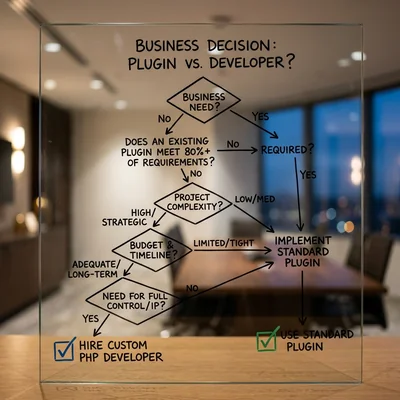
WordPress and PHP: What You Are Actually Buying
WordPress is a content management system (CMS) in PHP. Pages, posts, media, and settings live in a database (MySQL or MariaDB). Plugins are ready-made modules that plug in without editing the core: WooCommerce, Contact Form 7, Yoast SEO, WP Rocket, and thousands more. A theme is the look; often it is also tuned via a page builder (Elementor, Gutenberg).
For a business owner, it helps to separate three levels of work:
| Level | Who does it | Examples |
|---|---|---|
| Content | Editor, marketer | Copy, photos, publications |
| Setup | "WordPress" contractor, freelancer | Plugin install, menus, forms, basic SEO |
| Development | PHP developer, agency | Custom post types, API, integrations, query optimization |
Confusion starts when a contractor sells "WordPress site development" for $500, and six months later half the logic lives in paid plugins - and the business stops if you disable them.
When Plugins Are Enough
In most small projects you do not need a developer at launch and for the first 1-2 years if tasks fit the standard ecosystem.
Typical "plugins + setup only" scenarios
- Corporate site - 10-50 pages, blog, lead form, map, multilingual (WPML / Polylang).
- Landing for ads - page builder, A/B via external service, analytics via GTM.
- Catalog without online payment - products as "posts," "request a quote," no warehouse accounting in WP.
- WooCommerce "showcase" - up to 500-2,000 SKUs, standard payment and shipping in your region.
- SEO basics - sitemap, meta, schema via Yoast / Rank Math; no developer, but an annual SEO audit.
- "Out of the box" integrations - CRM via ready connector (AmoCRM, Bitrix24), mail via SMTP plugin.
Signs you are still in plugin territory:
- updating WordPress and plugins does not break the site more than once a year (and is fixed quickly by rollback);
- a new feature exists as a ready plugin with reviews and support;
- traffic is up to 3,000-5,000 visits per day, hosting is not hitting CPU limits;
- no requirement to "match our ERP inside WP without middleware."
Plugins that usually cover the stack
| Task | Typical solution | Comment |
|---|---|---|
| Forms | Contact Form 7, WPForms, Fluent Forms | Complex funnels - already on the edge |
| SEO | Yoast, Rank Math | Does not replace content and technical basics |
| Cache | WP Rocket, LiteSpeed Cache | Often enough on shared hosting |
| Backups | UpdraftPlus, Duplicator | Test restore, not just "backup exists" |
| Security | Wordfence, iThemes Security | Does not replace updates and strong passwords |
| E-commerce | WooCommerce | Extensions for subscriptions, B2B - check licenses |
Setup budget without development: $300-1,500 one-time (theme + plugins + basic structure) + $50-150/mo for hosting and premium plugin licenses.
When You Need a PHP Developer
A WordPress developer is not "someone who installs plugins." It is a specialist who reads and writes PHP, understands WordPress hooks, DB structure, security, and can build a child theme, mu-plugin, or REST API without hacks.
Signs plugins are no longer enough
| Symptom | Why a plugin will not save you |
|---|---|
| "Calculator with 15 fields and PDF to email" | Ready forms do not handle business rules |
| Catalog filter slows down at 10,000+ products | Need indexes, custom queries, code-level cache |
| Real-time ERP / warehouse integration | Stock connectors - CSV hourly, not API |
| Account area with roles beyond "customer / manager" | WooCommerce + 5 plugins = fragile chain |
| After WP update site fails monthly | Conflict of custom code and plugins |
| PCI, GDPR, audit log requirements | Need architecture, not a "security plugin" |
| Headless or mobile app with same catalog | Need REST/GraphQL, not admin UI |
If two or more items apply - budget for "PHP development," not "one more $79/year module."
What a developer does on a WordPress project
- Child theme and templates - markup without editing parent theme (so updates do not wipe changes).
- Custom post types and fields - sometimes via ACF, sometimes code if migration and versioning matter.
- WooCommerce: hooks, checkout, cart - rule-based discounts, B2B prices, stock sync.
- REST API / webhooks - for CRM, mobile app, marketplace.
- Optimization - slow queries, N+1, object cache (Redis), heavy jobs to cron.
- Security - input sanitization, capability checks, no
evalor nulled plugins. - Data migration - import from old site, Excel, another CMS.
Rates (guide, 2026): $50-120/hour freelancer CIS/Eastern Europe; agency - fixed from $1,000 for small customization to $15,000+ for custom WooCommerce module.
Plugins vs Custom Code: How to Choose
| Criterion | Plugin | Custom PHP |
|---|---|---|
| Time to launch | Days | Weeks |
| Startup cost | $0-300/year | $1,000-10,000+ |
| Flexibility | Limited by plugin author | Fit your process |
| Support | Depends on author | Your team / contractor |
| Risk on WP update | Medium-high | Lower with code review |
| Scale | Up to moderate load | Can optimize for growth |
Practical rule:
- Task is common (forms, SEO, backup) - use a proven plugin.
- Task is competitive advantage (pricing logic, unique account area, ERP integration) - custom, or you depend on someone else's roadmap.
- "Gluing" 4 plugins for one feature is often more expensive than one 200-line mu-plugin - but owners only see that after a year of downtime.
"Plugin Zoo": How Not to Drown
Typical picture after 2-3 years: 25-40 active plugins, half duplicate features, three not updated since 2022, 400 lines in functions.php from "the previous freelancer."
What the owner should do:
- Inventory every six months - list plugins, why each exists, can it be disabled.
- Staging - test copy; updates there first (Linux/VPS or hosting with staging).
- No nulled (cracked premium) - saving $89 turns into hack and Google penalties.
- One plugin - one job - two SEO plugins at once hurt.
- Document - who configured what, where custom code lives.
If inventory shows critical logic spread across 8 plugins and functions.php - that is a precursor to WordPress migration, not reason to "buy a ninth plugin."
Typical Scenarios and Budget
| Scenario | Plugins | Need PHP? | Budget guide |
|---|---|---|---|
| Business card + blog | Yes | No | $500-2,000 one-time |
| WooCommerce up to 1,000 SKUs | Yes + setup | Rarely | $1,500-5,000 |
| Service calculator, PDF, CRM | Partially | Yes | $2,000-8,000 |
| B2B catalog, role-based prices | WC extensions | Yes | $5,000-20,000 |
| API for app | Not out of the box | Yes | $8,000-30,000+ |
| 1C online integration | Connectors limited | Yes | $5,000-25,000 |
Hidden costs: premium theme and plugins ($200-600/year), hosting as you grow (VPS from $15-50/mo), developer support ($300-800/mo retainer for active store).
WordPress + Developer vs Changing Platform
Sometimes more PHP is cheaper than migration. Sometimes the opposite.
Stay on WordPress if:
- editors know the admin, lots of content;
- customization is local (one module, checkout, integration);
- budget is tight and Django/Python migration is $15,000+ and months of work.
Look at another stack if:
- PHP code and plugins duplicate ERP (orders, warehouse, finance);
- you need microservices, queues, complex API;
- every WP update is a lottery with 2-3 days downtime;
- security and compliance are not fixed by theme patches.
More on the tipping point — see WordPress migration cost.
Owner Checklist Before Paying
- Is the task solved by configuring an existing plugin or new code?
- Is there a spec with fields, roles, integrations - or only "make it like the competitor"?
- Who owns the code - repo, hosting access, documentation?
- Where do we test updates - staging or straight to production?
- What happens in 12 months if the catalog triples - same hosting, same plugins?
- Plugin licenses on your company, not the freelancer's email?
- Is there a rollback plan if an update fails?
"We do everything in Elementor and plugins, no code needed" when you ask for real-time stock sync with ERP - red flag.
Summary
WordPress on PHP is a rational choice for content, marketing, and typical e-commerce. Plugins cover most startup tasks without a developer. A PHP developer is needed when unique business logic, heavy integrations, performance, and security cannot be "bought" in the extension catalog.
Owners should:
- not confuse setup and development in the budget;
- watch plugin count and custom code;
- update WP and extensions on staging;
- after repeated breakages on update - order a code audit, not another plugin;
- know the threshold when migration beats endless patches.
A good WordPress project is invisible - the site works, leads flow, updates pass without panic. A bad one - when "one more plugin" treats the symptom, not the cause, and every Black Friday starts with checkout down.
If you need help with development, AI implementation, or website support for your project - contact me.
Frequently Asked Questions
Can I build a WooCommerce store without a developer?
Yes, for a typical store - up to 500-2,000 products, standard payment and shipping, without complex B2B pricing and real-time warehouse sync. You need a setup contractor (theme, WooCommerce, payment gateway, basic SEO) - $1,500-5,000. A developer is needed for non-standard discounts, subscriptions, 1C integration, marketplace, or wholesale account - otherwise in a year the site runs on five-plugin crutches.
How many plugins is "too many"?
No hard number, but 15+ active is reason for review. What matters more is duplication (two caches, two SEO), outdated with no updates, and dependency of critical functions on one author. If disabling one plugin breaks checkout or forms - architecture is fragile. Every six months list: plugin - why - can it be replaced by code or one alternative.
Should I update WordPress if "it works"?
Yes. Old WP and plugin versions are the main cause of hacks and search engine blacklists. "Don't touch what works" saves hours short term and costs days of downtime when hacked. Minimum: backup, staging, updates every 1-2 months, test forms and payment after. On shared hosting without staging, at least backup before each update.
What is the difference between "plugin setup" and "WordPress development"?
Setup - install, admin configuration, content, menus, permalinks, ready gateway. Development - PHP, child theme, hooks, SQL, API, changes for your rules. In proposals these are different lines: setup - $300-1,500 fixed; development - hours or sprints with spec. If a contractor "sets up" by editing functions.php without Git and comments - that is development without process, tech debt risk.
When is it better to leave WordPress than hire a PHP developer?
When patches never end and value is in data and processes, not the post admin. Signs: 10+ plugins for business logic, every update is risk, need API, enterprise-level roles, ERP integration deeper than CSV export. If annual "WP patching" budget matches migration ($15,000-40,000) - consider moving to Django or another backend. If the task is one (new checkout, CRM link) - a WordPress PHP developer is usually cheaper and faster than platform change.
Terms in this article
landing page — page built for a single conversion goal
plugin — installable extension module
CRM — Customer Relationship Management
tech debt — shortcuts in code that cost extra work later
contact form — web form for inbound messages
CMS — Content Management System
page builder — visual editor that builds pages from blocks
Yoast SEO — WordPress plugin for on-page SEO checks and sitemaps
GTM — Google Tag Manager
middleware — code layer between request and business logic
ERP — Enterprise Resource Planning
e-commerce — online selling of goods or services
restore — recover data from backup/snapshot
backup — copy kept for recovery
child theme — WordPress theme that safely overrides a parent theme
B2B — Business to Business
mu-plugin — WordPress must-use plugin loaded for every site
REST API — HTTP API that exposes resources via URLs and verbs
real-time — processed with minimal delay
audit log — chronologically recorded trail of who did what
object cache — fast store for computed objects (often Redis/Memcached)
headless — backend CMS/API without a built-in public frontend
GDPR — General Data Protection Regulation
GraphQL — query language for APIs with a typed schema
PCI — Payment Card Industry
webhooks — HTTP callbacks when events happen
code review — peer check of a change before it is merged
N+1 — N+1 query problem
roadmap — planned product timeline
downtime — period when the service is unavailable
staging — pre-production environment for final checks
production — live environment serving real users
rollback — revert to a previous working version after a failed change
Black Friday — peak retail shopping day
backend — server-side logic, APIs and data layer