How Much Does Python Development Cost: Bot, Parser, CRM Integration - Real Price Ranges
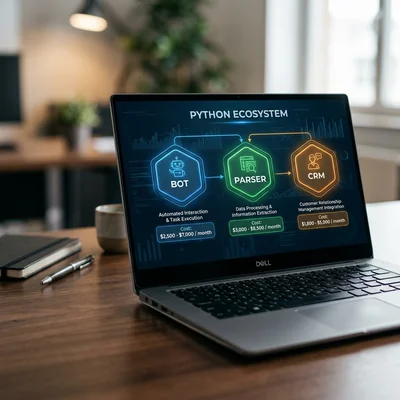
Python is the most common choice for business automation: messenger bots, competitor price scrapers, lead sync with CRM, background jobs, and APIs. Clients hear "Python is fast and cheap," then the quote shows $25,000 and three months - because price is driven not by the language but by logic scope, integrations, and reliability requirements. Below are realistic 2026 ranges for three typical tasks: bot, parser, CRM integration, what each tier includes, and how to avoid paying for an "MVP you cannot run in production."
- Simple Python bot (FAQ, notifications, menu) - $800 - $3,500, 1-3 weeks
- Bot with CRM, payments, roles - $5,000 - $20,000, 3-8 weeks
- Parser "scrape once and export to Excel" - $700 - $2,500, 3-10 days
- Scheduled parser with DB and monitoring - $3,000 - $15,000, 2-6 weeks
- CRM integration (form lead to Bitrix24/amoCRM) - $1,500 - $6,000, 1-3 weeks
- Two-way CRM + ERP + warehouse sync - $12,000 - $50,000+, 1-4 months
- Monthly costs - VPS, APIs, support: from $30 to $2,500+
- Main price driver - not Python, but number of integrations, edge cases, and SLA
Why Python for Bots, Parsers, and CRM
Python is chosen not because it is trendy, but because one stack covers different business tasks:
- Bots - aiogram, python-telegram-bot, pyTelegramBotAPI; WhatsApp/VK use separate SDKs and webhooks;
- Parsers - requests, httpx, BeautifulSoup, Scrapy, Playwright for JS sites;
- CRM and APIs - REST clients, Celery queues, FastAPI/Django middleware;
- Data - pandas, PostgreSQL, Redis, export to Google Sheets;
- AI layer - request classification, RAG over knowledge base, draft replies for agents.
One language simplifies maintenance: the same developer extends a price parser and CRM lead delivery. Alternative: n8n or Zapier for simple flows without custom logic; Python pays off when no-code hits branching, data volume, or non-standard APIs.
How Much a Python Bot Costs
Clients often mix an FAQ auto-reply with a corporate role-based system. Split by tiers - see Telegram bot cost.
Tier 1: simple bot - $800 - $3,500
Timeline: 1-3 weeks.
Includes:
- menu, buttons, text scenarios;
- FAQ from Google Sheets or simple admin;
- manager notification in Telegram on new lead;
- basic logging.
Excludes: payments, personal account, complex analytics, 99.9% SLA.
Stack: Python + SQLite/PostgreSQL + webhook on VPS for $5-20/mo.
Tier 2: bot with CRM and business logic - $5,000 - $20,000
Timeline: 3-8 weeks.
Typical features:
- order intake, appointment booking, client status updates;
- deal/contact in amoCRM, Bitrix24, HubSpot, Salesforce;
- payments (Stripe, PayPal, regional gateways);
- roles (client / manager / admin), segment broadcasts;
- Google Calendar, ERP via API or file exchange.
Price drivers: CRM fields and statuses, refunds, multilingual UI, content moderation.
Tier 3: enterprise bot - $20,000 - $80,000+
Timeline: 2-5 months.
Adds:
- SSO, audit trail, branch-level access;
- AI agent with escalation to human;
- analytics, A/B flows, DWH integration;
- high availability, queues, monitoring, on-call.
vs no-code: n8n automation is cheaper for "if lead then email CRM," but Python wins on complex dialogs and custom in-bot UI.
| Tier | Budget | Timeline | When enough |
|---|---|---|---|
| Simple | $800 - $3,500 | 1-3 wk | FAQ, lead capture, pilot |
| With CRM | $5,000 - $20,000 | 3-8 wk | Sales, booking, payments |
| Enterprise | $20,000 - $80,000+ | 2-5 mo | Chain stores, AI, compliance |
How Much a Python Parser Costs
A parser is not a "50-line script" but a data collection system accounting for blocks, layout changes, and legal limits.
One-time scrape to file - $700 - $2,500
Timeline: 3-10 business days.
Scenario: one or several sites, static HTML, output CSV/Excel.
Risks: site changes CSS classes - script breaks in a month; without maintenance agreement this is a one-off, not a product.
Scheduled parser with storage - $3,000 - $15,000
Timeline: 2-6 weeks.
Includes:
- schedule (cron, Celery Beat);
- PostgreSQL or MongoDB, price change history;
- pagination, captcha services, proxies if needed;
- alerts "competitor price dropped 10%" to Telegram/email;
- simple dashboard or Google Sheets export.
Price drivers: JS render (Playwright), tens of thousands of SKUs, geo proxies, rate limits.
Market monitoring platform - $15,000 - $50,000+
Timeline: 1-4 months.
For: e-commerce, distributors, marketplaces, niche price analytics.
Adds: product card normalization, dedup, API for internal systems, SLA, legal review of robots.txt and ToS.
Owner note: confirm with legal whether target sites allow scraping. Python can do it technically - not always legally.
| Parser type | Budget | Data refresh | Support/mo |
|---|---|---|---|
| One-off | $700 - $2,500 | Manual | $0 - $300 |
| Scheduled | $3,000 - $15,000 | Hourly - daily | $300 - $1,500 |
| Platform | $15,000 - $50,000+ | Real-time / near RT | $500 - $3,000+ |
How Much CRM Integration on Python Costs
"CRM integration" in a brief can mean one webhook line or a data bus across five systems.
Simple lead handoff - $1,500 - $6,000
Timeline: 1-3 weeks.
Scenarios:
- form on Django site → deal in amoCRM/Bitrix24;
- lead from Telegram bot → contact + task for manager;
- VoIP call → CRM record via connector or API.
Includes: field mapping, dedup by phone/email, API error handling, logging.
Two-way sync - $8,000 - $25,000
Timeline: 4-10 weeks.
Scenarios:
- order status from CRM → client notification in bot;
- warehouse stock → site and marketplaces;
- invoices from ERP → CRM (ERP API limits strongly affect timeline).
Price drivers: data conflicts ("source of truth"), historical migration, nightly batches, idempotency.
Integration bus / middleware - $15,000 - $50,000+
Timeline: 1-4 months.
When needed: multiple CRM, ERP, WMS, billing, marketplaces; unified transform layer on FastAPI/Django + queues (RabbitMQ, Redis).
Alternative without Python: n8n at $1,500 - $25,000 for typical chains - compare 2-year TCO if flows are stable and light on logic.
What Moves the Price Most
| Factor | Cheaper | More expensive |
|---|---|---|
| Brief | Clear fields and statuses | "Like competitor" |
| Integrations | 1 CRM, documented API | Legacy SOAP, no sandbox |
| Data | Up to 1,000 records/day | Millions of rows, streaming |
| Reliability | "Restart manually" | 99.9%, alerts, backup |
| UI | Bot/CLI only | Web admin, reports, roles |
| AI | None | RAG chatbot, classification |
| Team | Freelancer, fixed | Agency, SLA, docs |
Hidden cost lines:
- CRM sandbox - sometimes paid;
- Proxies and anti-captcha - $50-500/mo on parsers;
- Hosting - $10-200/mo VPS; Kubernetes from $300/mo;
- Support - 10-20% of build per year or $500-3,000/mo retainer;
- CRM API changes - vendor breaking updates.
How to Estimate Budget Before Signing
- Describe one happy path - "client tapped button → paid → landed in CRM with status X."
- Integration list - system name, API key exists, who owns access.
- Data volume - SKUs, leads, messages per day in 6 months.
- Who runs prod - dedicated DevOps or "dev's VPS."
- MVP vs prod - split "10 test users" vs "500 store chain."
Ask for two-phase quote: discovery (8-40 hours, $400-2,000) with fixed spec and implementation range. Cheaper than fixed $15,000 without ERP analysis.
Contractor Checklist Questions
- Which framework for bot (aiogram 3.x, FastAPI) and where hosted?
- Experience with your CRM (not "we did CRM in general")?
- Warranty when scraped site layout changes?
- Logs and alerts when integration fails at 2 AM?
- Who owns code and repo after payment?
- Hourly rate for post-delivery changes?
- Licenses for proxies, OCR, payments?
Answer "all inclusive, details later" - signal to add +30-50% to quote.
Python vs No-Code vs Ready Connectors
| Task | Python | n8n / Zapier | Ready connector |
|---|---|---|---|
| Form lead → CRM | Overkill | Optimal | Often enough |
| Telegram bot with payment | Optimal | Hard | None |
| Parser 50,000 SKUs | Optimal | Cannot scale | None |
| ERP sync | Often required | Rare | Depends on edition |
| AI bot on knowledge base | Optimal | Possible | Limited |
Practical mix: no-code for simple webhooks, Python for daily revenue-critical logic with tests and versioning.
When You Don't Need Python (Yet)
Python automation isn't always the right call - sometimes skipping it is cheaper and faster:
- One simple "if this, then that" scenario with no branching or custom logic - n8n/Zapier or a ready connector handle it in hours, not weeks.
- A one-off data export with no regular repeat - a manual export or a single freelance task covers it; a dedicated "parser system" won't pay for itself.
- Your lead or order flow hasn't stabilized yet (fewer than 10-20 per day, the process changes weekly) - it's too early to automate: stabilize the process manually first, then lock it into code.
- No budget or owner for ongoing support - a Python bot or parser doesn't work in "set it and forget it" mode: when the CRM API or site markup changes, it breaks, and your customers notice before you do.
- Data collection in a legal gray area - without a lawyer's review of robots.txt, ToS, and personal-data rules, a technically working parser can create reputational and legal risk.
If at least two of these apply, start with no-code or a manual process, and come back to Python once the business logic or data volume outgrows it.
Summary
Python development in 2026 spans wide ranges: bot from $800, parser from $700, CRM link from $1,500 - but production setups with integrations, monitoring, and support often land at $8,000 - $30,000 and up. The language does not make it cheap - clear spec, phased launch, honest MVP do.
Business owners should:
- start with one scenario (one bot, one lead flow, one parser source);
- reserve 15-25% for API surprises;
- plan monthly hosting and maintenance;
- for site leads, check if n8n at $2,000 is enough first;
- for payments and CRM, budget a Python project, not a "weekend script."
A good Python vendor states ranges and what pushes price up - before deposit, not after the third "small" sprint item.
Current guides on service pricing - on the pricing page.
If you need help with development, AI implementation, or website support for your project - contact me.
Frequently Asked Questions
Why is the same bot quoted at $2,000 and $25,000?
Because scope differs: cheap tier is menu, text, forward lead to chat; expensive tier is CRM, payments, roles, analytics, fault tolerance, months of support. Compare feature lists, not the word "bot." Ask for tiered estimate (MVP / prod) - see Telegram bot cost.
Can a competitor parser be done for $300 on a freelance site?
One-time scrape of a simple page - yes, sometimes $300-500 on marketplaces, but a reliable vendor floor is from $700. Regular monitoring of hundreds of SKUs, proxies, alerts - no: realistic floor $3,000+. Cheap script without maintenance breaks on first redesign - budget support or accept one-off data risk — see parsing cost.
Is Zapier cheaper than Python for CRM integration?
For 1-2 simple triggers - often yes: $20-100/mo SaaS vs $2,000+ one-time Python setup. But with complex logic, volume, self-hosting, and security, Python or self-hosted n8n wins over 12-24 months. Compare Zapier licenses + task limits vs fixed build + VPS.
How long does development take and when is the first result?
Simple bot or CRM webhook - 1-3 weeks to pilot on test users. Parser with DB - 2-4 weeks to stable exports. ERP sync - often 6-12 weeks due to approvals and test DBs. Allow 1-2 weeks for acceptance fixes after "done" - normal, not delay.
Is Django required if the task is only a bot or parser?
Not mandatory. Bot - aiogram + PostgreSQL; parser - Scrapy/Playwright + cron; integration - FastAPI or scripts + Celery. Django when you also need site, admin, accounts - see Django project cost. Do not pay for full framework for one 400-line microservice - but pay for deploy, logs, backups, or "cheap" becomes "down Monday morning."
Terms in this article
CRM — Customer Relationship Management
production — live environment serving real users
MVP — Minimum Viable Product
ERP — Enterprise Resource Planning
edge cases — rare inputs or scenarios that break the happy path
VPS — Virtual Private Server
SLA — Service Level Agreement
aiogram — async Python framework for Telegram bots
webhooks — HTTP callbacks when events happen
middleware — code layer between request and business logic
knowledge base — structured repository of answers/docs
FastAPI — modern Python framework for APIs
Celery — Python task queue for background jobs
RAG — Retrieval-Augmented Generation
no-code — building apps with visual tools, little or no programming
Zapier — SaaS that connects apps with no-code automations
n8n — open-source workflow automation platform
Salesforce — enterprise CRM cloud platform
Bitrix24 — suite with CRM, tasks, chat, and site tools
audit trail — verifiable history of actions and changes
HubSpot — CRM and marketing platform for inbound growth
amoCRM — CRM popular in CIS markets for sales pipelines
on-call — rotation where engineers respond to incidents outside office hours
SSO — Single Sign-On
DWH — Data Warehouse
dashboard — metrics/status panel
e-commerce — online selling of goods or services
real-time — processed with minimal delay
idempotency — repeating a request does not change the outcome again
sandbox — isolated environment for safe experiments and tests
happy path — main success scenario without errors or edge cases
TCO — Total Cost of Ownership
retainer — fixed monthly fee for ongoing support
chatbot — conversational bot interface
backup — copy kept for recovery
API key — secret token that authenticates API callers
DevOps — Development and Operations
OCR — Optical Character Recognition
self-hosting — running software on your own servers
self-hosted — software you run on your own servers
SaaS — Software as a Service