Turnkey AI Agent Development: Stages, Timeline, and Cost

In 2026, an AI agent is not "a chat with a button" - it is a system that plans steps on its own, calls APIs, works with CRM, email, knowledge bases, and reports results. Turnkey development covers task analysis, architecture, integrations, security, pilot, and production launch. Below are realistic stages, timelines, and budget ranges for business.
- Simple agent (1-3 tools) - $15,000 - $45,000, 4-8 weeks
- Corporate agent with RAG and CRM - $50,000 - $150,000, 3-6 months
- Enterprise: multiple agents, compliance, SLA - $150,000 - $450,000+, 6-12 months
- Monthly costs - API, hosting, monitoring, improvements: from $800 to $25,000+
- Key price driver - not the model (GPT-5.6, Claude Fable 5, Gemini 3.5 Flash), but integration depth and reliability of autonomous actions
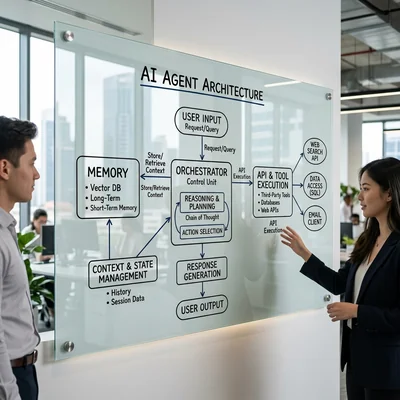
What "Turnkey AI Agent" Means
Turnkey means the client gets a working system: the agent runs agreed scenarios, connects to your systems, is documented, handed over to the team, and supported at launch. A typical delivery includes:
| Component | What is done |
|---|---|
| Discovery | Interviews, process map, KPIs, data constraints |
| Architecture | Model choice, orchestrator, memory, tools, fallback |
| Development | Agent backend, prompts, RAG, API connectors |
| Interface | Widget, Slack, Teams, internal panel, or headless API |
| Security | RBAC, action audit, personal data filters, code sandbox |
| Launch | Pilot, metrics, runbook, user training |
A chatbot mainly answers questions. An agent acts: creates a ticket, books a slot, builds a report, runs a chain of 5-15 steps with result validation. That is why timelines and budgets are higher than for an FAQ bot.
Development Stages
1. Analysis and Specifications (1-3 weeks)
You define:
- which tasks the agent automates (not "everything at once");
- which systems it touches (CRM, ERP, Jira, email);
- autonomy level: suggest action, execute with approval, or fully automatic;
- success metrics: request handling time, % without escalation, retrieval accuracy.
Output: technical specification, user stories, risk matrix (hallucinations, data leaks, incorrect transactions).
2. Architecture Design (1-2 weeks)
Stack selection:
- Orchestration: LangGraph, CrewAI, AutoGen, custom loop on OpenAI Agents / Anthropic tool use
- Model: GPT-5.6 Sol/Terra for complex chains, Claude Fable 5 for coding agents, Gemini 3.5 Flash for high traffic
- Memory: short-term (session history), long-term (vector DB, user profile)
- Tools: HTTP API, read-only SQL, Confluence/Notion search, calendar, document generation
Design human-in-the-loop: where an operator must approve an action, where the agent stops with an error.
3. MVP on One Scenario (3-6 weeks)
The first release covers one measurable process:
- "process incoming email and create a lead in CRM";
- "find an answer in the knowledge base and draft a client reply";
- "build a weekly report from three sources".
MVP includes logging of every agent step, a basic dashboard, and 20-50 test dialogs/runs.
4. Integrations and RAG (4-10 weeks)
The main share of work on corporate projects:
- connectors to internal APIs (OAuth, VPN, IP whitelist);
- RAG on up-to-date documents: chunking, rerank, source citation;
- reference data sync (prices, order statuses, SLA);
- edge cases: empty API response, timeout, data conflict.
Without quality retrieval, the agent "confidently makes mistakes" - plan iterations on search quality.
5. Testing and Pilot (2-4 weeks)
Check not only "nice demos" but also:
- regression on a set of real cases;
- load (parallel sessions, API rate limits);
- security (prompt injection, attempts to call forbidden tools);
- escalation UX to a human.
Pilot - 5-15% of real traffic or one department. Collect CSAT, task success rate, average steps to result.
6. Production and Handover (1-3 weeks)
- CI/CD, staging/prod, secrets in vault;
- alerts on error growth and token cost;
- documentation for admins and users;
- internal team training (1-2 sessions).
7. Support and Evolution (ongoing)
Typically 15-30% of development cost per year: new tools, RAG updates, model changes, improvements from feedback.
Timelines by Project Type
| Agent type | Time to production | Comment |
|---|---|---|
| Task agent (one workflow, 1-3 APIs) | 4-8 weeks | Good for pilot and narrow automation |
| Department assistant (RAG + CRM + email) | 3-6 months | Main time - integrations and quality |
| Agent platform (multiple roles, RBAC) | 6-12 months | Compliance, audit, multi-tenancy |
| Adding a second scenario to ready core | +4-8 weeks | Cheaper if architecture is built for extension |
Timelines grow not because of "writing a prompt" but because of approvals, access to client test environments, and tuning reliability of autonomous actions.
Cost: What It Includes
| Block | Share | Example work |
|---|---|---|
| Discovery and specs | 8-12% | Workshops, process map, KPIs |
| Architecture | 5-10% | Stack choice, tools schema, threat model |
| Agent core development | 35-45% | Orchestrator, state, retry, observability |
| Integrations | 20-35% | CRM, ERP, tickets, calendars, custom API |
| RAG and data | 10-20% | Indexing, ETL, retrieval eval |
| UI and admin | 5-15% | Widget, operator panel, logs |
| Launch and pilot | 8-12% | Tests, training, hypercare at start |
Price Ranges by Complexity
1. Simple task agent - $15,000 - $45,000
- one scenario, 1-3 tools (API, email, spreadsheet);
- no complex RAG or ready base up to 500 pages;
- model: GPT-5.6 Luna/Terra, Gemini 3.5 Flash;
- interface: Slack bot or internal webhook.
2. Corporate agent - $50,000 - $150,000
- RAG on company documents, source citation;
- CRM integrations (HubSpot, Salesforce, Bitrix24), tickets, calendar;
- human-in-the-loop, roles, audit;
- 2-4 related workflows.
3. Enterprise platform - $150,000 - $450,000+
- several specialized agents (sales, support, analytics);
- SSO, on-prem or VPC, DLP, compliance logging;
- SLA, 24/7 monitoring, custom eval and red-team;
- scaling to branches and languages.
Monthly Costs (OPEX)
| Item | Range | Depends on |
|---|---|---|
| LLM API | $300 - $20,000+ | Agent steps, context length, model |
| Infrastructure | $200 - $8,000 | Self-hosted vs cloud, vector DB, workers |
| Support | $1,500 - $15,000 | Studio retainer or 0.25-1 FTE in-house |
| RAG updates | $500 - $5,000 | How often products/policies change |
In agent scenarios, token spend is 3-10x higher than for a simple chatbot: each step is a separate model call plus tool results in context.
How to Cut Budget Without Losing Quality
- One scenario in MVP - do not try to automate the whole department at once.
- Ready connectors - MCP, Zapier, n8n for non-critical integrations instead of custom API from scratch.
- Model by task level - Luna/Flash for classification and routing, Sol/Fable 5 only on complex steps.
- Cache and deduplication - do not run repeated reference lookups through the LLM.
- Eval from sprint one - dataset of 50-100 real cases; without it you pay for endless "prompt tweaks".
- Fixed MVP, T&M for growth - agree on a fixed price for the first workflow and transparent rate for the next ones.
When a Turnkey AI Agent Is Not the Right Choice
- A one-off or rare task - if the process runs only a few times a month, doing it manually or with a simple no-code flow is cheaper than custom development.
- No process owner or system access - without someone on the client side responsible for integrations and data, the project stalls in approvals.
- You need a result with zero room for error and no human check - for legally binding or irreversible actions, the agent still needs an approval loop, which changes both timeline and cost.
- No budget for post-launch support - an unsupported agent degrades as vendor APIs, company policies, and data change.
- The task saves less than the system costs to own - if the process volume is small, ROI will not work out even with a solid implementation.
In these cases a simpler option usually makes more sense: a ready-made no-code flow, a plain FAQ bot, or improving the existing process without agentic logic.
Summary
Turnkey AI agent development in 2026 is a project from $15,000 (narrow task agent) to $450,000+ (enterprise platform). Timelines - from 4-8 weeks to 12 months. Main drivers: number of integrations, autonomy level, security requirements, and volume of unique business rules. Start with one measurable process, build in observability and human-in-the-loop, calculate TCO for 12-24 months - that makes it easier to justify budget and avoid disappointment with "autonomy" on paper.
Current guides on service pricing - on the pricing page.
If you need help with development, AI implementation, or website support for your project - contact me.
Frequently Asked Questions
How is an AI agent different from a chatbot?
A chatbot mainly generates dialog answers. An AI agent plans a chain of actions: calls APIs, reads and writes to systems, branches by result, can wait for approval and retry on error. An agent costs more and takes longer to build, but covers processes, not just questions.
Can you build an agent with no-code in a couple of days?
For a prototype - yes. n8n, Make, Zapier with AI steps, OpenAI Assistants API let you quickly link email and a spreadsheet. For production with SLA, audit, complex RAG, corporate security, and custom logic, no-code quickly hits a ceiling. A realistic turnkey business agent is custom development or a hybrid: no-code for simple links, code for the agent core.
Which models are best for agents in 2026?
It depends on the task. GPT-5.6 Sol and Claude Fable 5 are strong in long agentic chains and code/tools work. GPT-5.6 Terra and Claude Sonnet 5 balance price and quality for corporate scenarios. Gemini 3.5 Flash - high traffic and long context. Routing is common: a cheap model on simple steps, flagship on planning and hard decisions.
How much does support cost after launch?
Rule of thumb - 15-30% of development cost per year plus OPEX for API and infrastructure. Minimum contractor retainer - $1,500 - $3,000/mo (small fixes, monitoring). On an actively evolving enterprise project, an in-house team of 0.5-1 FTE or a contract of $8,000 - $15,000/mo is normal practice.
How to estimate ROI before starting development?
Calculate time savings on the target process: (hours per week x employee hourly cost x automation share) x 52. Add qualitative effects: faster client response, fewer errors when moving data to CRM. Compare with TCO over 18 months: development + OPEX + support. If payback is 12-18 months with task success rate above 80% in pilot - the project is usually justified; if lower - narrow the scenario or strengthen human-in-the-loop.
Terms in this article
CRM — Customer Relationship Management
production — live environment serving real users
RAG — Retrieval-Augmented Generation
SLA — Service Level Agreement
orchestrator — component that coordinates steps/services
fallback — backup path used when the primary option fails
backend — server-side logic, APIs and data layer
headless — backend CMS/API without a built-in public frontend
widget — embedded UI component
sandbox — isolated environment for safe experiments and tests
RBAC — Role-Based Access Control
runbook — step-by-step playbook for incidents and operations
chatbot — conversational bot interface
retrieval — finding relevant context before generation
orchestration — coordinating multiple services or workflow steps
LangGraph — framework for stateful AI agent workflows
human-in-the-loop — human approval before risky agent actions
Confluence — Atlassian wiki for team documentation
knowledge base — structured repository of answers/docs
dashboard — metrics/status panel
edge cases — rare inputs or scenarios that break the happy path
chunking — splitting documents into retrieval-friendly pieces
regression — bug where a previously working feature breaks again
MVP — Minimum Viable Product
rerank — reorder search results by relevance
timeout — max wait before aborting
staging — pre-production environment for final checks
CSAT — Customer Satisfaction Score
observability — logs, metrics and traces to understand system behavior
CI/CD — Continuous Integration / Continuous Delivery
retry — automatic repeat of a failed request or job
self-hosted — software you run on your own servers
webhook — HTTP callback when an event happens
ERP — Enterprise Resource Planning
vector db — database for similarity search over embeddings
on-prem — software hosted in your own infrastructure
ETL — Extract, Transform, Load
retainer — fixed monthly fee for ongoing support
LLM API — HTTP API to call a large language model
in-house — done by the company's own team
SSO — Single Sign-On
VPC — Virtual Private Cloud
DLP — Data Loss Prevention
Zapier — SaaS that connects apps with no-code automations
FTE — full-time equivalent headcount
no-code — building apps with visual tools, little or no programming
MCP — Model Context Protocol
agentic — agent-like autonomous multi-step behavior
n8n — open-source workflow automation platform
T&M — time and materials billing
long context — model that can take a very large prompt in one go
ROI — Return on Investment
TCO — Total Cost of Ownership
OPEX — operating expenses