What Is Shopify: An Online Store Without a Developer - Features, Pricing, and Limitations

Shopify is a cloud e-commerce platform (SaaS): catalog, cart, payments, shipping, and admin are built in, with hosting and updates included in the plan. For a business owner, it is one of the fastest ways to start selling online without a development team - pick a theme, add products, connect a domain and payment provider. But Shopify is not a magic button: fees, paid apps, checkout customization limits, and vendor lock-in quickly change the TCO picture. Below: what Shopify does out of the box, real 2026 pricing, platform limits, and when you cannot avoid hiring a developer.
- Shopify fits - D2C brands, small and mid-size e-commerce, multichannel sales (site + social + POS)
- Plans - from $5/mo (Starter) to $399+/mo (Advanced); Shopify Plus from ~$2,300/mo
- Hidden costs - 0.5-2% fee without Shopify Payments, apps ($10-100+/mo), theme, Liquid custom work
- Without a developer - typical store up to 500-3,000 SKUs, standard shipping and payments
- Developer needed - custom checkout (Plus), ERP, headless storefront, complex pricing and inventory logic
- Main risk - ecosystem dependence: migrating catalog and orders to WooCommerce or Django is a separate project
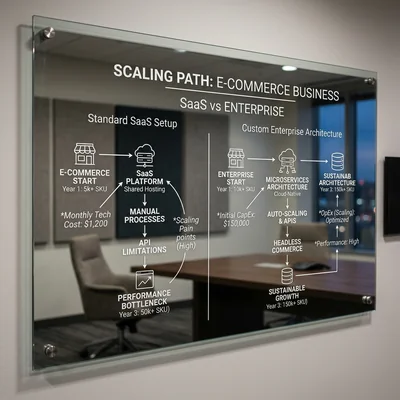
What Shopify Is in Plain Terms
Shopify is an "online store in the browser" service. You sign up, choose a theme (storefront template), upload products, configure payment and shipping - and the store runs on Shopify servers. No CMS on hosting, no PHP updates, no assembling WooCommerce from a dozen plugins like on WordPress.
Technically, Shopify is a proprietary e-commerce platform: storefront code uses the Liquid template language; order and customer data live in Shopify cloud. For business, that is a plus (less technical routine, PCI DSS on the platform side) and a minus (you do not fully own code and DB as with self-hosted solutions).
How Shopify Differs from Builders and CMS
| Criterion | Shopify | Wix / builders | WordPress + WooCommerce |
|---|---|---|---|
| Focus | E-commerce | Site + basic store | General CMS + store |
| Start without code | Yes | Yes | Yes, with plugins |
| Hosting | Included | Included | Separate ($5-50+/mo) |
| Catalog scale | Up to tens of thousands of SKUs | Usually hundreds-thousands | Depends on hosting |
| Checkout | Standard; custom on Plus | Basic | Flexible with plugins |
| Ecosystem | App Store (8,000+ apps) | App Market | WooCommerce plugins |
| Migration | Hard | Hard | Easier (your server) |
Shopify wins when sales are the core of the business, not "a cart page on a business card site." For a pure landing page without sales, Wix or Tilda is often cheaper and simpler.
Who Shopify Is For
Ideal Scenarios
- D2C brand - apparel, cosmetics, accessories: one catalog, domestic or global shipping, promo codes, email marketing.
- Small and mid-size store - 20 to 5,000 SKUs, standard variants (size, color), no B2B portal with individual pricing.
- Multichannel sales - site + Instagram/Facebook + marketplaces via integrations + offline via Shopify POS.
- Quick MVP - validate demand in 1-3 weeks without custom development investment.
- Dropshipping - ready apps for suppliers (Oberlo-style tools, DSers, etc.).
When Shopify Is a Poor Fit
- Complex B2B - individual pricing, credit limits, legal-entity orders with VAT and e-invoicing.
- Marketplace - multiple sellers on one platform with split payouts (needs custom or specialized platform).
- Heavy integrations - ERP, SAP, custom WMS with real-time two-way sync.
- Unique checkout - multi-step funnel, code-level checkout A/B (limited below Plus).
- Strict data control - requirement to store personal data only on your servers in a specific jurisdiction.
- Content site without sales - blog, portfolio, service landing: Shopify is excessive and more expensive than alternatives.
If 2-3 items from the second list apply, budget for Shopify Plus, a custom app, or migration to another stack within 12-18 months.
How Much Shopify Costs
Price is made up of plan, transaction fees, apps, theme, and contractor work.
Plans (USD, 2026 guide)
| Plan | Price/mo | For whom | Key points |
|---|---|---|---|
| Starter | ~$5 | Sales on social and messengers | Payment links, no full storefront |
| Basic | ~$39 | Store launch | Full online store, 2 staff accounts |
| Shopify (Grow) | ~$105 | Growing sales | More reports, up to 5 warehouse locations |
| Advanced | ~$399 | Scale | Advanced analytics, up to 15 staff, lower fees |
| Plus | from ~$2,300 | Large brand, B2B | Custom checkout, Shopify Flow, SLA |
With annual billing, discount is usually ~25% - calculate TCO over 12 months, not just the first month.
Shopify Fees (Without Shopify Payments)
If you use third-party acquiring (not built-in Shopify Payments), the platform charges an additional fee per order:
| Plan | Fee without Shopify Payments |
|---|---|
| Basic | 2.0% |
| Shopify (Grow) | 1.0% |
| Advanced | 0.6% |
| Plus | 0.2-0.4% (individual) |
Plus payment provider fees (Stripe, PayPal, etc.) - usually 2.9% + $0.30 per transaction. At $50,000/mo revenue, an extra 1-2% Shopify fee is $500-1,000/mo "platform tax."
What the Plan Does Not Include
| Item | Guide | Comment |
|---|---|---|
| Domain | $10-20/year | Buy via Shopify or bring your own |
| Paid theme | $0-350 one-time | Many quality themes are $180-350 |
| App Store | $10-100+/mo total | Email, reviews, subscriptions, upsell, SEO |
| Liquid custom work | $50-150/hour | Theme customization, new sections |
| Content and photos | $500-5,000+ | Shoot, copy, catalog setup |
| SEO audit | $500-2,500 | If organic is the main channel |
Example annual TCO (small store): Basic ($39 x 12 = $468) + theme ($200) + 3 apps ($30 x 12 = $360) + domain ($15) + contractor setup ($1,200) = ~$2,250/year excluding ads and sales fees.
What Shopify Gives You Without a Developer
For a typical store, owner or marketer covers 80% of tasks in admin:
- Catalog - products, variants, collections, CSV import, digital goods.
- Design - themes, drag-and-drop section editor (Online Store 2.0), mobile layout.
- Cart and checkout - standard payment funnel, guest checkout, promo codes, gift cards.
- Payments - Shopify Payments, PayPal, Stripe, and dozens of local providers (country-dependent).
- Shipping - zones, rates, carrier integrations, checkout calculation.
- Orders and customers - statuses, refunds, basic segmentation, export.
- Marketing - discounts, email (Shopify Email), Meta/Google integration.
- Analytics - sales reports, funnel, LTV (deeper on higher plans).
- POS - offline sales with inventory sync.
- Blog and pages - basic content for SEO; tight for serious content marketing.
Typical no-code store launch: 1-4 weeks with ready products, photos, and copy.
Shopify Limitations
Understanding the platform ceiling saves money on "rebuilds in six months."
Technical and Product Limits
- Checkout - on Basic/Grow/Advanced, checkout customization is limited (Shopify Checkout Extensibility helps but is not full custom). Full control - Shopify Plus.
- Liquid templates - more flexible than drag-and-drop, but that is code; without skills you need a contractor.
- URL and structure - better than early builders, but fine control over HTML and markup lags self-hosted CMS.
- Speed - heavy theme + 15 apps = Core Web Vitals drop; optimization often needs a developer.
- Multi-currency - Shopify Markets covers much, but complex scenarios (country-specific warehouses, local taxes) hit plan and app limits.
- Subscriptions and complex models - partly via apps (Recharge and similar), +$50-200/mo and integration risks.
Economic Limits
- Bill growth - each new app +$10-50/mo; at $100k+/mo revenue, fees and Plus pay off; at launch they hurt.
- Ecosystem lock-in - data can be exported, but logic (discounts, automations, custom fields) moves manually.
- Payments - in some countries Shopify Payments is unavailable; Shopify fee + third-party acquiring hits margin.
Vendor Lock-in
Like Wix, "leaving Shopify" is a project: export products, move orders and customers, 301 redirects, redesign. Migration budget for 500-2,000 SKUs - $5,000-20,000+.
When You Need a Developer on Shopify
Shopify is positioned as no-code for merchants, but the development boundary comes early.
Theme Customization (Liquid, CSS, JavaScript)
You need a Shopify developer if:
- the theme does not support required UX (12-parameter filter, lookbook, configurator);
- unique design is required, not "another template";
- fine speed optimization and CSS work is needed.
Rates: $50-150/hour; typical theme work - $1,500-5,000 fixed.
Apps and API
- Public or custom app - ERP, CRM, warehouse integration, custom discount logic.
- Shopify Functions - server-side pricing and shipping logic on Shopify (developer required).
- Webhooks + external backend - inventory sync, notifications, antifraud.
Typical CRM integration - $2,000-8,000; ERP - $10,000-50,000+.
Headless and Shopify Plus
- Headless storefront (React/Next.js + Storefront API) - maximum storefront freedom, but needs frontend + backend team.
- Shopify Plus - custom checkout, Shopify Flow, B2B features, dedicated support. Justified at $1M+/year revenue or strict funnel requirements.
Signs It Is Time for Custom, Not Shopify
| Symptom | What happens | Where to look |
|---|---|---|
| 10+ paid apps | Conflicts, bill growth, speed drop | Simplify stack or custom |
| ERP sync "on duct tape" | Inventory errors, manual fixes | Custom backend / middleware |
| Marketplace needed | Shopify is not multi-vendor | Separate platform |
| Legal data requirements | Data in Shopify cloud | Self-hosted, Django |
| Checkout beyond Extensibility | Ceiling on regular plans | Plus or leave platform |
Shopify vs Alternatives: Brief
Shopify vs Wix - Shopify when sales are the foundation; Wix for a business site with a small store. More in the Wix article.
Shopify vs WooCommerce (WordPress) - Shopify faster to launch and easier to maintain; WooCommerce more flexible with plugins and potentially cheaper at scale on your hosting, but more technical work.
Shopify vs builders (Tilda, Webflow) - builders for content and landings; Shopify for full e-commerce with orders and inventory.
Shopify vs Django/custom - Shopify for standard D2C; custom for unique logic, API, marketplace, and full code ownership. Budget guide - Django development.
Summary
Shopify is a top choice for launching an online store quickly without a developer: catalog, payments, shipping, and admin are ready. Plans run from $5 (Starter) to $399+/mo (Advanced), plus fees, apps, and themes. Without a developer, you can run a store up to several thousand SKUs with standard logic. A developer is needed for custom themes, integrations, headless, and tasks beyond the App Store.
Before an annual Advanced contract, ask: "Where will we be in 18 months?" If the answer is ERP, marketplace, and unique checkout, Shopify saves time now but may require Plus ($2,300+/mo) or migration to another stack.
If you need help with development, AI implementation, or website support for your project - contact me.
Frequently Asked Questions
Can I open a Shopify store without a developer?
Yes, for a typical scenario. Catalog, theme, payments, shipping, and promo codes are set up in admin. A developer is needed for unique design, complex filters, ERP integration, or custom checkout (on regular plans checkout is barely touched).
How much does Shopify really cost per month for a small store?
Guide: $50-150/mo at launch: Basic plan (~$39) + 1-3 apps ($10-50) + theme amortization. Plus payment fees and, without Shopify Payments, an extra Shopify % (up to 2% on Basic). Ads and setup contractor are separate.
How is Shopify better than WooCommerce on WordPress?
Shopify wins on launch speed, updates, checkout security, and less technical routine. WooCommerce wins on flexibility, code control, and potentially lower TCO at scale with hosting and a contractor. Compare "plugins vs developer" on WordPress in WordPress on PHP.
Can I migrate a store from Shopify to another platform?
Yes, but it is a project, not a button. Products and customers export via CSV/API; orders - partially. Design is rebuilt; 301 redirects are critical for SEO. Migration budget for 500-2,000 SKUs - $5,000-20,000+. Plan before you accumulate dozens of custom apps and automations.
Do I need Shopify Plus and when does it pay off?
Shopify Plus (from ~$2,300/mo) suits large brands at $1M+/year revenue, custom checkout, B2B scenarios, and strict SLA. For small D2C on Basic or Grow, Plus is excessive. If you hit checkout and fee limits on Advanced - first compare Plus TCO vs custom development.
Terms in this article
e-commerce — online selling of goods or services
SaaS — Software as a Service
vendor lock-in — hard to leave a vendor without costly rewrite
TCO — Total Cost of Ownership
headless — backend CMS/API without a built-in public frontend
storefront — customer-facing shop UI
ERP — Enterprise Resource Planning
CMS — Content Management System
app market — marketplace of apps/extensions
app store — store of apps for a platform
landing page — page built for a single conversion goal
Tilda — block-based website and landing page builder
B2B — Business to Business
MVP — Minimum Viable Product
POS — Point of Sale
real-time — processed with minimal delay
SLA — Service Level Agreement
upsell — selling a higher-tier offer
no-code — building apps with visual tools, little or no programming
Core Web Vitals — Google metrics for loading, interactivity, and visual stability
self-hosted — software you run on your own servers
LTV — lifetime value of a customer
lock-in — hard to leave a vendor or stack without costly rewrite
server-side — logic that runs on the server, not in the browser
webhooks — HTTP callbacks when events happen
CRM — Customer Relationship Management
backend — server-side logic, APIs and data layer
frontend — client-side UI of a site or app
middleware — code layer between request and business logic