Bitrix24, amoCRM, or HubSpot - What to Choose in 2026?

Bitrix24, amoCRM, and HubSpot are the three most common candidates when a business decides to adopt CRM. But they are not three identical boxes at different prices: each system has its own philosophy, strengths, and hidden costs. Bitrix24 is an all-in-one portal (CRM, tasks, chats, site). amoCRM is built for sales and messengers in the CIS region. HubSpot is the standard for inbound marketing and B2B in Western markets. Below is an honest 2026 comparison: who each fits, full TCO, and how to avoid a wrong choice.
- Bitrix24 - CRM + tasks + portal; free up to 12 users; strong in CIS and corporate processes
- amoCRM - short pipeline, WhatsApp/Telegram, fast start for sales teams
- HubSpot - free CRM, powerful marketing; gets expensive as you scale; best for EN markets
- Choice - not by ratings, but by lead channels, team, budget, and region
- Pilot - 2-4 weeks on one CRM with real deals, then scale
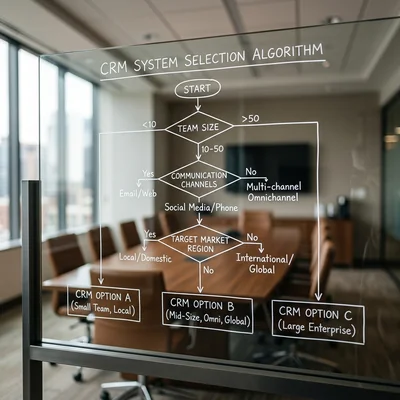
Three Different CRM Philosophies
Before comparing prices, it helps to understand why each system was built:
| Criterion | Bitrix24 | amoCRM | HubSpot |
|---|---|---|---|
| Focus | Whole company: CRM, HR, tasks, drive | Sales team and short cycle | Inbound: content, leads, nurturing |
| Region | CIS, Eastern Europe, local integrations | Russia, CIS, messengers | US, Europe, global EN |
| Complexity | High: many modules | Medium: fast start | Medium (CRM), high (Marketing Hub) |
| Free start | Up to 12 users | Limited trial | Free CRM forever |
| Typical user | 5-100 people, need a cloud office | 2-30 sellers, leads from chats | Marketing + B2B sales in the West |
If you are not sure CRM is needed at all - check 7 signs it is time to adopt CRM. If you need a system but budget is unclear - see how much CRM implementation costs.
2026 rule: do not pick CRM from forum reviews. List 5-7 must-have scenarios (lead capture from site, call from card, WhatsApp, pipeline report, manager task) and run them in each system's trial.
Bitrix24: When to Choose It
Bitrix24 is not only CRM but a corporate portal: deals, tasks, calendar, chats, drive, sometimes site and HR. For a company that wants one window instead of ten services, that is a strong argument.
Strengths
- Free plan up to 12 users - a real start without a card (with limits).
- CRM + tasks + communications in one ecosystem: fewer integrations.
- Deep customization: pipelines, robots, business processes, access rights.
- Local market: many integrators in CIS, links to 1C, telephony, marketplaces.
- Online office: video calls, knowledge base, workgroups.
Weaknesses
- Cluttered interface - managers get lost without training.
- Implementation often costs more than licenses - without setup Bitrix24 becomes another messenger.
- Mobile app is capable but heavier than amoCRM for field sales.
- Marketing automation weaker than HubSpot in Western markets.
Pricing (2026 ballpark)
| Plan | Ballpark | For whom |
|---|---|---|
| Free | $0, up to 12 users | Pilot, micro team |
| Basic / Standard | from ~$25-60/mo per portal | 5-20 people, CRM + tasks |
| Professional / Enterprise | custom | 20+ users, robots, rights, SLA |
Full TCO with implementation for a 10-person team is often $3,000-15,000 in year one (licenses + setup + 1-2 integrations).
Bitrix24 fits if:
- you need not only CRM but tasks, chats, documents for the whole company;
- team is 5-50+ people, several departments;
- local integrations matter (1C, regional telephony, marketplaces);
- you can invest 2-4 weeks in setup and training.
amoCRM: When to Choose It
amoCRM is CRM for sellers: short pipeline, deal card, messenger and ad integrations. Less portal, more lead handling speed.
Strengths
- Fast start - pipeline and card make sense to a manager in 1-2 days.
- Messengers - WhatsApp, Telegram, Instagram at the center (critical for CIS and e-commerce).
- Ad integrations - form leads, UTM, basic attribution.
- Mobile app - among the best for field managers.
- Digital pipeline - visual funnel the team adopts in hours, not weeks.
Weaknesses
- Does not replace a corporate portal - tasks and documents weaker than Bitrix24.
- Scaling to 50+ users and complex B2B - not always optimal.
- Marketing - email and nurturing simpler than HubSpot.
- Global expansion - UI and ecosystem tuned for CIS.
Pricing (2026 ballpark)
| Plan | Ballpark | For whom |
|---|---|---|
| Basic | from ~$6-12/user/mo | 2-5 sellers |
| Advanced / Professional | from ~$18-30/user/mo | integrations, automations |
| Enterprise | custom | large pipelines, API |
A team of 5 managers - ~$50-150/mo licenses + $500-3,000 one-time implementation.
amoCRM fits if:
- main channels are site, ads, WhatsApp, Telegram, Instagram;
- team is 2-25 sellers, focus on lead response speed;
- you need launch in a week, not a month-long project;
- business is in CIS, deal cycle from days to 1-2 months.
HubSpot: When to Choose It
HubSpot started as inbound marketing and still shines where leads come through content, SEO, email sequences, and nurturing. HubSpot CRM is free, but real power is in paid Hubs.
Strengths
- Free CRM with no contact limit (automation limits apply).
- Marketing Hub - among the best for email, landing pages, lead scoring.
- Sales Hub - sequences, playbooks, Gmail/Outlook integration out of the box.
- Ecosystem - thousands of integrations, standard for startups and B2B SaaS in the West.
- Training and docs - Academy, templates, English best practices.
Weaknesses
- Price grows in steps - Sales Hub + Marketing Hub for 5-10 people easily hits $500-2,000+/mo.
- Weaker in CIS context - messengers, 1C, local telephony need workarounds.
- Ecosystem lock-in - migration to another CRM hurts more than from amoCRM.
- English-first UI - barrier for a purely Russian-speaking team without EN.
Pricing (2026 ballpark)
| Product | Ballpark | For whom |
|---|---|---|
| CRM Free | $0 | Contacts, deals, basic pipeline |
| Sales Hub Starter | from ~$20/user/mo | Sequences, email templates |
| Sales Hub Professional | from ~$90/user/mo | Automations, reports, forecasting |
| Marketing Hub | from ~$50-890/mo | Email, landing pages, nurturing |
A team of 5 on Sales Pro + basic marketing - $400-1,500/mo licenses only.
HubSpot fits if:
- market is US, Europe, global B2B in English;
- content marketing, email sequences, lead scoring matter;
- deal cycle is long, many touches before payment;
- team already uses Gmail, Google Workspace, Slack and accepts a Western SaaS stack.
Comparison Table: Bitrix24 vs amoCRM vs HubSpot
| Parameter | Bitrix24 | amoCRM | HubSpot |
|---|---|---|---|
| Start without budget | Yes (up to 12 users) | Trial | Yes (CRM Free) |
| Implementation speed | 2-6 weeks | 3-10 days | 1-3 weeks |
| Messengers (CIS) | Yes, via integrations | Core strength | Weak |
| Marketing / email | Basic | Medium | Core strength |
| Tasks and portal | Core strength | Basic | Via integrations |
| B2B long cycle | Good | Medium | Excellent |
| E-commerce / short cycle | Medium | Excellent | Medium |
| Licenses 5 users/mo | $0-150 | $50-150 | $0-500+ |
| Year 1 TCO (SMB) | $3,000-15,000 | $2,000-8,000 | $3,000-20,000+ |
| Migration | Medium difficulty | Easier | Harder |
Figures are ballparks; exact TCO depends on integrations. Complex stacks (site + ERP + telephony) are often cheaper via business process automation on n8n or Zapier than waiting for a native module.
How to Choose: Step-by-Step
Step 1. Fix your lead channels
| Channels | Lean toward |
|---|---|
| WhatsApp, Telegram, Instagram, Avito | amoCRM |
| Site + SEO + email in EN | HubSpot |
| Mixed + portal for whole company | Bitrix24 |
Step 2. Assess team size and maturity
- 1-5 sellers, need fast results - amoCRM.
- 5-30 people, several departments - Bitrix24.
- Marketing 2+ + sales in the West - HubSpot.
Step 3. Calculate 12-month TCO
Do not compare only per-user price. Add: implementation, integrations, training, support. Ranges in CRM implementation cost.
Step 4. Pilot on real deals
2-4 weeks, 2-3 managers, 20-50 live leads. Metrics: first response time, % lost leads, % filled cards, stage conversion.
Step 5. Scale or migrate
If the pilot works - onboard the rest. If not - do not force the wrong system: early migration is cheaper than a year of chaos.
When It's Not Worth Implementing CRM Yet
CRM is not just a license - it's a process you'll have to maintain. Sometimes it's more honest to postpone implementation or use a simpler tool for now:
- No repeatable sales process - if every deal goes differently and managers work from memory, CRM will just record the chaos instead of fixing it. Map the pipeline on paper first.
- Team of 1-2 people who already track every deal - a spreadsheet or task list covers the need faster and cheaper than setting up a full CRM.
- No one owns the rollout - without at least one person who keeps cards filled in and trains new hires, the system quickly turns into a tool nobody uses.
- Budget covers only the license - as the TCO above shows, setup and training often cost more than the subscription; if there's only enough for the license, it's better to wait until there's room for the rest.
Conclusion
Bitrix24, amoCRM, and HubSpot solve different problems. amoCRM is the best start for a CIS sales team with leads from ads and messengers. Bitrix24 fits a company that needs CRM plus tasks, chats, and portal in one. HubSpot is the inbound and B2B standard in English-speaking markets but gets expensive as you grow.
In 2026 the winner is not the most popular CRM but the one managers actually fill every day. Start with a pilot, measure conversion in 2-3 months - then buy advanced plans.
If you need help with development, AI implementation, or website support for your project - contact me.
Frequently Asked Questions
Can I try all three CRMs for free?
Yes. Bitrix24 - free plan up to 12 users. amoCRM - 14-day trial (sometimes longer promos). HubSpot - free CRM with no expiry. Tip: do not compare by clicking menus - run the same scenario in each system: site lead, call, task, stage change.
What is best for small business in Russia and CIS?
For pure sales and messengers, amoCRM is often chosen - faster start and clearer for managers. If you need tasks, chats, and documents for a 5-15 person company - Bitrix24 on free or basic plan. HubSpot makes sense if clients and marketing are in English and Western markets.
Which CRM for B2B with a long deal cycle?
HubSpot is stronger in nurturing, email sequences, and lead scoring on long cycles. Bitrix24 if you also need projects, tasks, and complex access rights. amoCRM if the cycle is up to 1-2 months and the main goal is not losing a lead in a messenger, not year-long nurturing.
How much does switching from one CRM to another cost?
Simple migration (up to 3,000 contacts, one pipeline) - $500-2,000 and 1-2 weeks. Medium (call history, custom fields, integrations) - $2,000-8,000, 2-4 weeks. Complex (10,000+ records, ERP, custom robots) - $8,000-25,000+. The earlier you admit a bad fit, the cheaper migration is.
Do you need HubSpot if the company works only in CIS?
Usually no, without inbound marketing in English and Western clients. HubSpot is weaker in local messengers and 1C integrations. Exceptions: SaaS with global plans, B2B export, marketing team already on HubSpot Academy. For local sales amoCRM or Bitrix24 are usually more practical and cheaper on TCO.
Terms in this article
Bitrix24 — suite with CRM, tasks, chat, and site tools
amoCRM — CRM popular in CIS markets for sales pipelines
HubSpot — CRM and marketing platform for inbound growth
CRM — Customer Relationship Management
B2B — Business to Business
TCO — Total Cost of Ownership
pipeline — sequence of processing stages
must-have — required capability or requirement
knowledge base — structured repository of answers/docs
SLA — Service Level Agreement
UTM — Urchin Tracking Module
marketing hub — marketing CRM hub/module
landing pages — pages built for conversion goals
lead scoring — ranking leads by likelihood to buy
sales hub — sales CRM hub/module
SaaS — Software as a Service
lock-in — hard to leave a vendor or stack without costly rewrite
e-commerce — online selling of goods or services
Zapier — SaaS that connects apps with no-code automations
SMB — Small and Medium Business
n8n — open-source workflow automation platform