How Much Do Tokens Cost: Calculating OpenAI, Claude, and Gemini API Spend

The API bill often surprises more than the sticker price: the model charges per input and output token, not per “one request.” Below - how OpenAI, Claude, and Gemini billing works, how to forecast a monthly budget, and where businesses usually overpay.
- Token - the billing unit: roughly 3-4 characters or part of a word
- Input wins on volume, output is pricier per 1M - long context hits the bill harder than a short smart answer
- Formula -
(input_tokens / 1M) × input_price + (output_tokens / 1M) × output_price - July 2026 baselines - GPT-5.6 Luna/Terra/Sol, Claude Sonnet 5 / Opus 4.8 / Fable 5, Gemini 3.5 Flash / 3.1 Pro
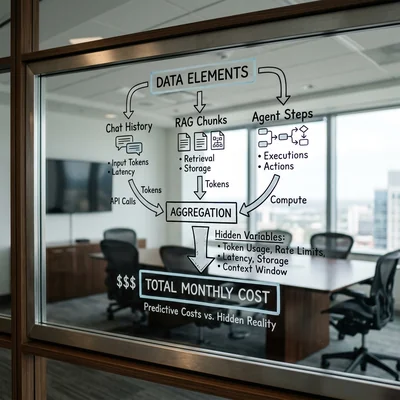
- Hidden costs - system prompt, chat history, RAG chunks, retries, tool calls
- Savings - smaller model for routine, caching/batch, trimmed context, escalate to a flagship only on hard cases
What a Token Is and Why It Is Not a “Word”
A token is a text fragment after the model’s tokenizer. It is not always a whole word: “programming” may become 2-3 tokens, and spaces and punctuation count too. For rough sizing:
| Language / text type | Rough guide |
|---|---|
| English | ~750 words ≈ 1,000 tokens |
| Dense prose | ~1 A4 page ≈ 500-800 tokens |
| Code | often “costlier” than words: more short tokens |
| Tables / JSON | look compact, but tokens grow fast |
Exact splits depend on the provider tokenizer - so for billing use usage in the API response, not a gut estimate. For the per-request limit, see context window.
How API Pricing Works
All three vendors share one pattern:
- Count input tokens (system + user + history + attachments/chunks).
- Count output tokens (model answer; sometimes reasoning/thinking separately).
- Apply a rate per 1 million tokens (1M), separately for input and output.
- Cost per call:
cost = (input_tokens / 1_000_000) × price_input
     + (output_tokens / 1_000_000) × price_output
Important nuances:
- Output is almost always more expensive per 1M than input - often 4-6× - so long answers and “reasoning” inflate the bill fast.
- Long context costs more above a threshold on some models (OpenAI GPT-5.6 above 272K; Gemini 3.1 Pro above 200K).
- Batch API and prompt caching cut price on repeated system/RAG context - if the architecture allows it.
- ChatGPT / Claude / Gemini Workspace seats are a different cost line - do not confuse them with per-token API. Platform comparison for people: ChatGPT vs Claude vs Gemini.
July 2026 Rates: Planning Baselines
Prices change - verify the official list before production. Below are working baselines from the July 2026 model overview (USD per 1M tokens, standard).
OpenAI (GPT-5.6)
| Model | Role | Input / 1M | Output / 1M |
|---|---|---|---|
| GPT-5.6 Sol | Flagship: code, agents | $5.00 | $30.00 |
| GPT-5.6 Terra | Price/quality balance | $2.50 | $15.00 |
| GPT-5.6 Luna | High-volume and background work | $1.00 | $6.00 |
Above 272K input, GPT-5.6 uses a long-context rate (baseline: input ×2, output ×1.5).
Anthropic (Claude)
| Model | Role | Input / 1M | Output / 1M |
|---|---|---|---|
| Claude Fable 5 | Coding, long agentic workflows | $10.00 | $50.00 |
| Claude Opus 4.8 | Enterprise, hard daily work | $5.00 | $25.00 |
| Claude Sonnet 5 | Text and instructions (intro until 2026-08-31) | $2.00 | $10.00 |
From 2026-09-01, Claude Sonnet 5 baseline: $3.00 / $15.00 per 1M.
Google (Gemini)
| Model | Role | Input / 1M | Output / 1M |
|---|---|---|---|
| Gemini 3.1 Pro | Hard reasoning | $2.00 | $12.00 |
| Gemini 3.5 Flash | High traffic, long context | $1.50 | $9.00 |
Gemini 3.1 Pro above 200K tokens uses a higher rate (baseline: $4.00 / $18.00 per 1M).
Calculation Examples
Example 1. Support reply: short dialog
Per ticket:
- input: 1,200 tokens (instructions + question + 2 history turns);
- output: 400 tokens;
- volume: 50,000 tickets / month.
| Model | Cost per ticket | Per month |
|---|---|---|
| GPT-5.6 Luna | ≈ $0.0036 | ≈ $180 |
| Gemini 3.5 Flash | ≈ $0.0054 | ≈ $270 |
| GPT-5.6 Terra | ≈ $0.009 | ≈ $450 |
| Claude Sonnet 5 | ≈ $0.0064 | ≈ $320 |
| Claude Fable 5 | ≈ $0.032 | ≈ $1,600 |
For L1 support a flagship almost never pays off: retrieval quality and permission to say “I don’t know” beat the top benchmark.
Example 2. Contract summary with large context
Per document:
- input: 80,000 tokens (PDF + system);
- output: 2,000 tokens;
- volume: 2,000 documents / month.
| Model | Cost per document | Per month |
|---|---|---|
| Gemini 3.5 Flash | ≈ $0.138 | ≈ $276 |
| GPT-5.6 Luna | ≈ $0.092 | ≈ $184 |
| GPT-5.6 Terra | ≈ $0.23 | ≈ $460 |
| Claude Sonnet 5 | ≈ $0.18 | ≈ $360 |
| Claude Opus 4.8 | ≈ $0.45 | ≈ $900 |
| Claude Fable 5 | ≈ $0.90 | ≈ $1,800 |
Here the main cost is input. It is cheaper not to “answer shorter,” but not to ship the whole PDF when relevant chunks via RAG are enough.
Example 3. Tool-using agent: the hidden multiplier
One “user request” for an agent is often 5-20 model calls (plan → tool → observe → plan again). If every step carries the full system + history:
agent_cost ≈ cost_of_one_call × number_of_steps
10 steps at 8K input / 500 output on Terra is no longer “one chat for a few cents,” but real dollars per hard case. Budget agent traces, not UI messages.
Where Businesses Overpay
- One flagship for everything. Sol / Fable 5 for email classification and FAQ is a classic budget leak.
- Fat system prompt + full history on every call. Repeated context without caching multiplies input.
- Unbounded RAG chunks. Ten “just in case” chunks cost more than two relevant ones - and quality drops.
- Retries and fallback uncounted. Timeout → retry → second model = double bill for one user click.
- Long output “just in case.” High
max_tokens+ vague prompt = the model writes a novel. - Seat vs API confusion. A Team subscription does not cancel token bills for product, bots, and automations.
- Ignoring long-context rates. Cross the 200K/272K threshold - the rate jumps while the dashboard still shows an “average” price.
How to Build a Monthly Budget
A practical template for finance and CTOs:
- Split traffic into scenarios (support chat, summarization, agent, embeddings separately).
- For each scenario take the median input/output from logs (not a perfect demo request).
- Multiply by monthly request / agent-step volume.
- Add a 20-40% buffer for retries, peaks, and experiments.
- Plan model switching: pilot on a smaller model + escalate to a larger one by rules.
Mini planning table:
| Scenario | Requests / mo | Median input | Median output | Model | $ / mo |
|---|---|---|---|---|---|
| L1 chat | 80,000 | 1,500 | 350 | Luna / Flash | … |
| PDF review | 3,000 | 40,000 | 1,500 | Sonnet / Terra | … |
| Agent (steps) | 15,000 steps | 6,000 | 400 | Terra / Opus | … |
| Total + 30% reserve | … |
Without such a table, picking the “smartest model” is a lottery, not finance.
How to Cut Spend Without Losing Quality
- Model routing. Classification and drafts - Luna / Flash / Sonnet; hard code and long agentic chains - Sol / Fable 5.
- Context engineering. Trim history, keep system short, do not duplicate the same instructions. See context engineering.
- RAG instead of “stuff everything in the prompt.” Less input - lower bill and less hallucination risk from noise.
- Prompt caching and batch. Repeated instructions and overnight batch jobs are often cheaper than realtime.
- Hard output limits. Structured output (JSON) instead of essays; explicit length caps.
- Escalate, don’t default. Cheap model first; expensive model on low confidence or hard task types.
- Observability. Log
usageby feature/tenant - otherwise there is nothing to optimize.
When Token Optimization Is Not Worth the Effort
- Low request volume. If the API bill is a few dollars a month, not a meaningful cost line, the team time spent on model routing and caching will cost more than it saves.
- Pilot or MVP stage. Before the product has proven demand, iteration speed matters more than exact per-token cost - add optimization once traffic is stable.
- No one to maintain the setup. Model routing, RAG, and chunk limits need someone watching
usagelogs and escalation rules - without that, a complex scheme quickly turns into "worse and more expensive" than a single flagship model. - The cost of a mistake beats the cost of a token. For legal, medical, and financial answers, do not switch to a cheaper model to save a percentage - quality and predictability matter more here.
Bottom Line
Token cost is not “the model price from the rate card,” but input volume × rate + output volume × rate × number of calls. In 2026 a sensible business stack is usually: a cheap fast model for volume, mid-tier for working documents, flagship only pointwise. Count from real-log scenarios, include agent chains and retries - then the API stops being a month-end surprise.
If you need help with development, AI implementation, or website support for your project - contact me.
Frequently Asked Questions
How do input tokens differ from output on price?
Output is almost always more expensive per 1M, sometimes 4-6×. But the final bill is often inflated by input: long documents, chat history, and RAG chunks. Watch both parts of usage, not only “how much the model wrote.”
How many tokens are in an average user message?
A short English question is often 20-80 tokens. With system prompt, policies, and 10 history turns, one “chat” easily becomes 1,000-5,000+ input before the answer. For budgeting, measure the full request, not only the customer phrase.
What is better for high traffic: Gemini Flash, GPT Luna, or Claude Sonnet?
For mass classification, FAQ, and short answers, Gemini 3.5 Flash and GPT-5.6 Luna often win. Claude Sonnet 5 is chosen when style, instruction-following, and careful text matter at still-moderate price. Confirm with A/B on your dataset, not only the price table.
Should you always pick the most expensive model “just in case”?
No. An expensive model pays off on hard tasks: long code, agentic chains, strict reasoning needs. On a stream of similar requests the overpay is wasted - use routing and rule-based escalation instead.
How can you estimate a monthly bill if there are no logs yet?
Take 20-50 real prompts, run them through the API, capture usage, average input/output, multiply by forecasted request volume, and add 30% for retries and growth. After 1-2 weeks replace the estimate with production medians - the error usually drops by multiples.
Terms in this article
long context — model that can take a very large prompt in one go
system prompt — hidden instructions that steer the model for a task
RAG — Retrieval-Augmented Generation
chunks — small text pieces indexed for retrieval
tokenizer — splits text into model tokens
context window — maximum text a model can process at once
prompt caching — reuse of a cached prompt prefix to cut cost and latency
production — live environment serving real users
long-context — model that can take a very large prompt in one go
agentic workflows — multi-step flows where an AI agent plans and acts
baseline — reference measurement before changes
retrieval — finding relevant context before generation
fallback — backup path used when the primary option fails
timeout — max wait before aborting
retry — automatic repeat of a failed request or job
dashboard — metrics/status panel
agentic — agent-like autonomous multi-step behavior
hallucination — model invents unsupported facts
structured output — model response forced into a fixed schema (JSON etc.)
observability — logs, metrics and traces to understand system behavior
tenant — isolated customer account in a shared platform
MVP — Minimum Viable Product