AI Hallucinations - What They Are and How to Reduce Business Risk

An AI hallucination is a confident, coherent, and plausible model answer that does not match the facts, your knowledge base, or the real state of your systems. For business the danger is not awkward wording - it is output that looks ready to act on: prices, deadlines, legal wording, order statuses, code advice. Below - what hallucinations are in plain language, where risk is critical, and a practical set of controls that cut damage without abandoning AI.
- Hallucination - a plausible but false or unverifiable LLM answer
- Risk - decisions, money, customers, reputation, and legal wording
- Causes - missing context, stale data, weak prompt, no verification
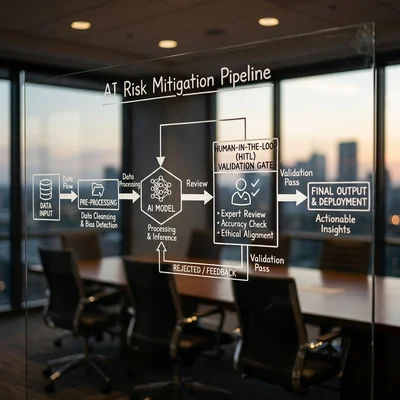
- Mitigation - RAG, grounded answers, human-in-the-loop, evals
- No silver bullet - even a strong model errs; you need a control architecture
- Start - one scenario with an error KPI, not “AI everywhere at once”
What AI Hallucinations Are in Plain Language
A large language model (LLM) predicts the next piece of text by probability. It does not “know the truth” in the everyday sense and does not check your CRM on its own. When data is scarce, contradictory, or the task needs an exact reference to an internal document, the model fills gaps: dates, numbers, names, “as if it were obvious.”
Typical business forms:
| Type | Example | Why it hurts |
|---|---|---|
| Factual error | Wrong tax ID, price, delivery date | Customer gets false information |
| Invented citation | “Per clause 4.2 of the contract…” - no such clause | Legal and reputation risk |
| False status | “Order shipped” without an API check | Support and logistics in chaos |
| Product mix-up | Competitor tariff described as yours | Marketing and sales ship defects |
| Overconfident tone | Error stated as fact with no caveat | Staff skips verification |
A hallucination rarely looks like nonsense. More often it is carefully worded falsehood - that is why it slips through.
Why Models “Make Things Up”
Short causes that matter to a business owner:
- Little or no context. The model answers from general knowledge, not your base. Context engineering and RAG help here.
- Stale model knowledge. Tariffs, laws, stock levels, and company policies change faster than model weights.
- Weak task setup. A vague prompt with no answer format and no permission to say “I don’t know.”
- Pressure to be complete. If the system must “always answer the customer,” the model prefers to invent rather than admit a gap.
- Complex multi-step chains. An AI agent or multi-agent setup accumulates errors: one wrong step poisons the result.
- Temperature and “creative” mode where facts are required. For references and statuses, prefer a stricter deterministic mode and structured output.
Separate two problems: imperfect prompting and no source of truth. A polished prompt without access to current data will not fix price and stock hallucinations.
Where Risk Is Critical for Business
Not all scenarios are equally dangerous. Rank by cost of error:
High risk (no control = do not ship):
- prices, discounts, contract terms, SLAs;
- legal and tax wording;
- medical, financial, HR advice presented “as fact”;
- system actions: write-offs, deletes, sending mail to customers;
- chatbot answers about order status without a backend check.
Medium risk:
- internal email and report drafts with human review;
- summarizing long documents with spot checks;
- analysis support where a manager owns the final call.
Low risk:
- brainstorming ideas;
- drafting a presentation outline;
- rewriting already verified text.
Simple rule: the closer the answer is to money, the customer, and irreversible action - the stricter the verification loop.
How to Reduce Risk: A Practical Control Stack
1. Grounding and RAG
Do not ask the model to “remember” the price list. Pass fragments from a current knowledge base and require answers only from them, with links to document/paragraph. For corporate knowledge build a RAG system: retrieve relevant chunks + generate from what was found.
Minimum rules:
- if no relevant fragments - answer “insufficient data”;
- cite the source (document id, version date);
- do not mix “model opinion” and “fact from the base” in one paragraph unmarked.
2. Permission to say “I don’t know”
In the system instruction, explicitly:
- forbid inventing numbers, dates, contract clauses;
- require stating uncertainty;
- escalate to a human when data is missing.
Without this, any “polite” model will fill silence with pretty text.
3. Structured output and tools instead of free-form storytelling
Where truth lives in a system - let the model call a tool/API, not reason about order status. Status, price, stock come from CRM, ERP, warehouse; the model formats the answer on top of the fact.
Flow:
Customer question
     │
     ▼
Classify: fact / advice / action
     │
     ├─ fact → API / DB / RAG → answer + source
     ├─ advice → draft → human (if risk)
     └─ action → human approval → tool
Same in AI in CRM: scoring and drafts - yes; changing deal stage and mailing customers alone - only with rules and approval.
4. Human-in-the-loop on critical steps
A human approves:
- amounts and commercial offers;
- outbound customer messages on contested topics;
- production changes and payments.
This is not “distrust of AI” - it is operational control, without which a pilot will not reach production.
5. Evaluation and quality regression
Collect 50-200 real questions with a gold answer or clear criteria. Before release, measure:
- share of answers without a source;
- share of factual errors on critical fields;
- share of false document references;
- average time to escalate to a human.
Without metrics you improve “demo vibes,” not risk.
6. Limit agent role and permissions
Narrow role + narrow tool set = less damage from a hallucination. A support agent must not delete deals. An orchestrator should not pass a raw full log to a subagent - only a brief. See multi-agent systems practice.
7. Knowledge versions and expiry
Documents in the base need a date and an owner. A policy like “chunks older than 90 days - do not use for prices” cuts a whole class of errors. Same idea for prompts and tariffs in prompt / RAG / fine-tuning comparisons: fine-tuning does not replace a live price list.
Checklist Before Launching AI in a Customer Channel
| Question | Yes / no |
|---|---|
| Is there a single source of truth (DB, docs, API)? | |
| Must the model cite a source or refuse? | |
| Do critical actions require human approval? | |
| Are question, context, answer, and prompt version logged? | |
| Is there a test set and an error threshold for release? | |
| Is it clear who owns an incident (a role, not “the AI”)? |
If more than two answers are “no” - too early for auto-replies to customers. Keep the assistant for internal drafts.
When You Don’t Need This Whole Loop
The control stack above is overkill for some cases - size it to real risk, don’t take the whole list “just in case”:
- Internal drafts only, never reaching a customer. If a human always checks the AI answer before use, the risk is already covered - full RAG and formal evaluation can wait.
- A single low-risk scenario with no growth in volume. Brainstorming, outlining a presentation - pushing this to production-grade control is wasted effort with no payoff.
- No one owns monitoring after launch. If nobody reviews logs and handles complaints, do not turn on customer auto-replies at all: the checklist above can be formally satisfied but still fail without a process owner.
- The manual process is not yet stable. Automating actions (write-offs, emails, status changes) before humans have a stable process just speeds up the same errors instead of removing them.
In these cases the right move is not to build a control loop, but to keep AI in an internal, checked scope, or delay rollout until monitoring resources exist.
Common Rollout Mistakes
- Shipping a site chatbot without RAG and without “I don’t know.”
- Asking the model to “be helpful at any cost” - it starts inventing.
- Confusing a demo on ideal questions with production on messy customer phrasing.
- Giving agents broad rights “just in case.”
- Not monitoring answers after release: hallucinations surface via complaints, not metrics.
- Believing a “smarter” model replaces a control architecture.
Bottom Line
AI hallucinations are not a “bad vendor bug” - they are a property of generative models: they fill gaps with plausible text. For business the job is not to ban AI, but to design a loop where the model cannot quietly lie about prices, statuses, and obligations. Foundation - current sources, permission to say “I don’t know,” tools instead of guesses, humans on risks, and regular quality checks. Then AI speeds work up instead of creating a costly stream of confident errors.
If you need help with development, AI implementation, or website support for your project - contact me.
Frequently Asked Questions
Can AI hallucinations be eliminated completely?
Fully - no, if you mean free-form text generation. You can sharply reduce damage: ground answers in sources, forbid invention, pull facts from APIs/DBs, and verify critical fields. The business goal is manageable risk, not a “perfect model.”
Does RAG guarantee the model will not lie?
No. RAG lowers risk when retrieval finds the right fragment and the prompt forbids going beyond it. If retrieval returns irrelevant or stale text, the model can still assemble a convincing but wrong answer. You need index quality, document versions, and refusal on weak match.
Is human-in-the-loop always required?
On risks - yes. For internal team drafts you can relax control. For customer answers about money, contracts, and system actions - human confirmation or a hard backend rule is mandatory at launch and often stays in production.
Will a more expensive model (GPT / Claude / Gemini) help?
A stronger model usually follows instructions better and breaks less on hard text, but it does not replace current data and checks. For facts about your business, grounding and tools matter more than the chat brand. Compare “model + architecture,” not only a browser chat demo.
Where should a small business start in 1-2 weeks?
Pick one scenario (e.g. FAQ answers from a knowledge base). Connect 20-50 documents, enable “I don’t know,” log answers, collect 30 gold questions, measure error rate. Only after a quality threshold connect customers - and keep human escalation for contested cases.
Terms in this article
hallucination — model invents unsupported facts
knowledge base — structured repository of answers/docs
LLM — Large Language Model
human-in-the-loop — human approval before risky agent actions
RAG — Retrieval-Augmented Generation
evals — quality checks and test suites for model outputs
KPI — Key Performance Indicator
CRM — Customer Relationship Management
structured output — model response forced into a fixed schema (JSON etc.)
chatbot — conversational bot interface
backend — server-side logic, APIs and data layer
human review — manual check by a person
chunks — small text pieces indexed for retrieval
ERP — Enterprise Resource Planning
production — live environment serving real users
orchestrator — component that coordinates steps/services
fine-tuning — additional training of a model on domain data
retrieval — finding relevant context before generation
grounding — answers anchored to sources