What Is Prompt Engineering for Business

Prompt engineering for business is not “knowing how to write nicely in ChatGPT.” It is a systematic practice of writing instructions for LLMs so that marketing, sales, support, and analytics get a predictable result: the right format, tone, facts, and constraints. Unlike a one-off chat, in a company a prompt becomes part of a process - a team template, a system instruction for a chatbot, or a layer next to context engineering and RAG. Below - what that means in practice, which techniques work in 2026, and how to roll it out without chaos where “everyone has their own prompt in notes.”
- Prompt - the input instruction: role, task, format, examples, prohibitions
- For business - repeatability, quality control, and lower risk of model errors
- Foundation - role + goal + task context + response structure + done criteria
- Techniques - few-shot, step chains, JSON schemas, checklists, human-in-the-loop
- Boundary - a prompt does not replace company data; documents and pricing need RAG
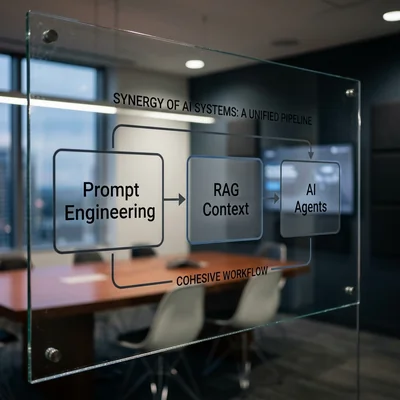
- Stack - prompt + context + tools/agents deliver a stable product, not a “lucky chat”
In Plain Terms: What Prompt Engineering Is
A prompt is the text you give a language model: a question, a task, a system role, a set of rules. Prompt engineering is the discipline that makes that input controllable: the model consistently produces what the business needs, not “something that sounds true.”
In a business context it is closer to writing a brief than to copywriting:
| Casual chat | Prompt engineering in a company |
|---|---|
| “Write a post about CRM” | Role + audience + USP + length + CTA + ban on inventing case studies |
| Different results from every employee | One shared template in Notion/Wiki/CRM |
| “Like / don’t like” judgment | Checklist: facts, tone, format, compliance |
| Model knowledge “from the internet” | Prompt + your data (RAG, CRM, price list) |
| One-off effect | Prompt versions, A/B, quality metrics |
In short: prompt engineering turns AI from a “smart conversation partner” into a process tool.
Why Business Needs It - Not Only “Tech People”
Without prompt discipline a company pays three times: in API tokens, in people’s time spent editing, and in reputation for wrong answers to customers.
Typical benefits:
- Speed of content and operations - draft emails, descriptions, briefs, meeting summaries in minutes.
- A shared quality standard - a newcomer writes as structured as an experienced teammate with a good template.
- Fewer hallucinations on critical tasks - explicit bans (“don’t invent prices,” “if there is no data - say there is no data”).
- Cheaper support and lead qualification - ready scripts for AI in CRM and first-line responses.
- Preparation for agents - a solid prompt layer transfers more easily into multi-agent systems, where each sub-agent has its own brief.
Prompt engineering pays off where a task repeats dozens of times a week. One-off creative experiments can stay informal.
What a Working Business Prompt Contains
A universal structure (store it as a template):
- Role - who is answering: “senior B2B SaaS support manager,” not just “assistant.”
- Goal - what the output must be and for whom.
- Task context - product, customer segment, campaign constraints (no secrets in a public chat).
- Step-by-step instructions - what to do first, what to check, what not to do.
- Response format - table, JSON, a 5-paragraph email, bullets for a slide.
- Examples (few-shot) - 1-3 good “input → output” samples.
- Done criteria - how to know the answer can go to a human or a customer.
- Escalation - when to stop and call a person (discounts, legal wording, complaints).
Minimal frame:
Role: ...
Task: ...
Input data: ...
Rules: ...
Response format: ...
If data is insufficient: ...
The more critical the scenario (money, legal promises, personal data), the stricter the “Rules” and “If data is insufficient” blocks.
Techniques That Actually Work in 2026
You do not need hundreds of “hacks.” For business a small set is enough:
1. Role + constraints instead of “be helpful”
A vague ask produces a vague answer. Role sets tone and detail level; constraints cut risk.
Example: “You are a sales manager. Do not promise a discount. If the client asks for custom work - suggest a call. Answer - up to 120 words.”
2. Few-shot: show a sample, not only a rule
Models copy example structure better than an abstract “write professionally.” Two short good examples often beat a long theory instruction.
3. Structured output
For integrations and automation, ask for JSON, CSV, or fixed fields. That makes it easier to push the answer into CRM, n8n, or spreadsheets without cleaning prose by hand.
4. Split into steps
Break a hard task: extract facts first → then assessment → then draft email. One “do everything at once” fails more often. For agents this is a natural pattern; for a human in chat too.
5. Self-check at the end of the prompt
Add: “Before the final answer, check: any invented numbers? format respected? is there a CTA?” Models often catch their own simple mistakes on a second pass inside the same reply.
6. Version the templates
Keep prompt_v1, prompt_v2 with date and author. Otherwise in a month nobody remembers why “yesterday worked better.”
Where to Roll Out First
A practical order for small and mid-size businesses:
| Area | Example task | Why it is a good start |
|--------------------|------------------------|
| Marketing | Posts, email, service descriptions | Fast visible effect, low risk |
| Sales | Call summary, follow-up, qualification | Saves manager hours |
| Support | Draft reply from FAQ | Sits next to RAG over a knowledge base |
| HR / ops | Job descriptions, onboarding checklists | Repeatable texts |
| Analytics | Survey analysis, feedback clustering | Table/JSON format |
Do not start with an “autonomous agent for everything.” Start with 3-5 templates for the team’s most frequent tasks and rules: where to copy the prompt, who edits it, how a “bad answer” is flagged.
Prompt Engineering vs Context Engineering vs RAG
These three are often confused. They do not compete - they complement each other:
| Approach | Question it answers | When it is critical |
|---|---|---|
| Prompt engineering | How to ask and in what format to answer | Shared style, scenarios, behavior |
| Context engineering | What the model must see on a step | Agents, long dialogues, tools |
| RAG | Where to take company facts from | Prices, policies, contract terms |
Typical 2024-2025 mistake: believe a “perfect prompt” replaces a knowledge base. Typical 2026 mistake: drop prompt discipline and rely only on retrieval. Without a clear instruction even good context becomes a chaotic answer.
The right business stack:
- The prompt sets role, format, and prohibitions.
- Context/RAG supplies up-to-date facts within the model window.
- Tools/agents perform actions (create a CRM task, find a document).
- A human approves critical steps.
How to Measure That Prompts Work
Without metrics prompt engineering becomes taste talk. Simple KPIs:
- Share of answers with no edits (or edits under 20% of the text).
- Time on task before/after the template.
- Factual errors per 100 answers (especially support and sales).
- Format compliance - how often JSON/structure broke.
- Token cost per successful result - sometimes a short precise prompt is cheaper than a long “just in case” one.
Every 2-4 weeks collect 20-50 real cases, label “good / OK / bad,” and fix the template. That is cheaper than endless wording debates.
Typical Company Mistakes
- Secrets in public ChatGPT - customer personal data, contracts, API keys. You need corporate accounts, DPA, and a policy.
- One giant prompt for every case - blurs focus; a library of narrow templates is better.
- No owner - templates go stale after a price or offer change.
- Expecting a perfect answer on the first try - the normal loop is: AI draft → human edit → template improvement.
- Ignoring model limits - a prompt does not fix missing data, a weak product brief, or CRM chaos.
- Auto-publish without a human - for external customer replies even a “good” model is risky.
When Prompt Engineering Is Not Worth Rolling Out
It is not a universal tool - sometimes it is smarter not to spend time on it and just use plain requests:
- The task happens rarely (a couple of times a quarter) - maintaining and updating a template costs more than writing the request from scratch each time.
- There is no process owner - without someone who watches the templates and fixes them after a price or offer change, the prompt library goes stale fast and turns into dead weight.
- The answer carries legal or financial risk - discounts, contractual commitments, official statements to customers are better left to a human than trusted to a model's self-control inside a prompt.
- There is no access to company data - if the answer must rely on an exact price list, SLA, or knowledge base, and RAG or the integration is not ready yet, a prompt alone will not fix that.
- Expecting full autonomy without review - if the goal is “let AI decide everything without a human,” start not with a prompt but with rethinking the process and who is accountable.
Bottom Line
Prompt engineering for business is the discipline of controllable LLM instructions: role, goal, format, examples, prohibitions, and template versions. It gives speed and a shared standard where tasks repeat, but it does not replace company data or context architecture. Roll out narrowly: 3-5 templates, quality metrics, a process owner. Then grow RAG, tools, and agents - on top of clear prompts, not instead of them.
If you need help with development, AI implementation, or website support for your project - contact me.
Frequently Asked Questions
How Is Prompt Engineering Different from a Normal ChatGPT Query?
A normal query is one-off text “as it comes.” Prompt engineering is a reusable template with role, rules, format, and quality criteria that you can version and share with the whole team. The goal is a stable process result, not one lucky answer.
Do We Need a Dedicated “Prompt Engineer” on Staff?
Not necessarily at the start. For a small business a process owner (marketing lead, ops, product) and a template library are enough. A dedicated role pays off when AI is built into the product: many scenarios, A/B prompts, RAG and agent links, compliance requirements.
Will Context Engineering Replace Prompt Engineering?
No - it complements it. Context engineering decides which data reaches the model; the prompt still decides how to answer. Mature systems need both layers: without data the prompt hallucinates; without instruction, context answers chaotically.
How Can We Start Rolling Out in a Company Within a Week?
Pick one repeating task (for example, follow-up after a demo). Describe a good and a bad answer, build a template on the “role → task → rules → format” frame, test on 10 real cases, put it in the Wiki, and assign who edits the version. Scale only after the first measurable win in time or quality.
Can We Skip RAG If We Write a Very Good Prompt?
For general tasks - yes; for company facts - no. A prompt sets behavior, but it does not “know” your current price list, SLA, or internal policies. If answers depend on business documents, you need RAG or an explicit injection of fresh data into context - otherwise the model will invent confidently.
Terms in this article
prompt engineering — crafting instructions so the model answers reliably
chatbot — conversational bot interface
RAG — Retrieval-Augmented Generation
few-shot — prompting with a few examples
human-in-the-loop — human approval before risky agent actions
CRM — Customer Relationship Management
USP — Unique Selling Proposition
CTA — Call To Action
SaaS — Software as a Service
B2B — Business to Business
n8n — open-source workflow automation platform
knowledge base — structured repository of answers/docs
retrieval — finding relevant context before generation
API keys — secret tokens that authenticate API callers
DPA — Data Processing Agreement
SLA — Service Level Agreement
LLM — Large Language Model