Vibe Coding - What It Is and When It Is Dangerous for Business

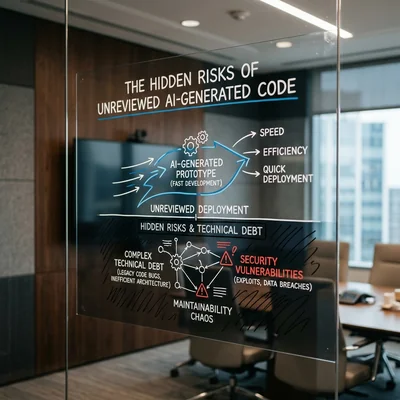
Vibe coding is an approach where you do not write code line by line - you talk to AI: describe the desired behavior, accept the model’s suggestion, check the result “by feel,” and refine the prompt. The term was popularized by Andrej Karpathy: you no longer hold the whole codebase in your head - you steer intent. For business this speeds up prototypes and internal tools - and at the same time creates hidden debt if the artifact lands in production without review, tests, and an architecture owner.
- Core idea - code via prompts in Cursor, Copilot, Claude Code, and similar assistants
- Upside - speed for MVPs, landing pages, scripts, and admin panels “needed yesterday”
- Downside - AI confidently writes code that “works” but is weakly secured and hard to maintain
- Danger zone - money, personal data, payments, CRM and server access
- Safe zone - drafts, one-off utilities, pilots under strict code review
- Rule - vibe for speed of an idea; engineering for code that carries the business
What vibe coding is in plain words
Classic development: a person designs, writes, debugs, and tests. Vibe coding shifts the focus:
- You state the task in natural language.
- The AI assistant generates files, diffs, tests, configs.
- You run it, watch behavior, and correct with a prompt (“make the form nicer,” “add auth”).
- The loop repeats until the “vibe” matches expectations.
This is not a separate language or framework. It is a way of working with AI coding assistants: less manual typing, more direction and verification.
| Mode | Who “leads” | Typical outcome |
|---|---|---|
| Classic code | Developer | Predictable architecture, higher control |
| Assisted coding | Human + AI hints | Faster routine without losing ownership |
| Vibe coding | Dialogue with the model | Fast artifact, ownership of code is blurred |
| Agent mode | An AI agent edits the repo itself | Even higher speed and “black box” risk |
In practice the line between “assisted” and “vibe” is thin: if you read the diff and understand every change - you are an amplified developer. If you approve batches of code because “the UI seems to work” - that is vibe coding with all the consequences.
Why business likes it
Vibe coding hits the pain of owners and product managers:
- Speed to a first demo - days instead of weeks.
- Less backlog dependency for small internal needs.
- Cheaper experiments: landing hypothesis, calculator, bot, parser.
- Broader circle of people who can assemble a draft without a deep senior background.
For a startup at the idea stage or for internal team automation this is a real lever. For a payment flow, a personal area with personal data, or a module that carries revenue 24/7 - a different level of responsibility.
When vibe coding is useful
Use it as an accelerator if several conditions hold:
- The artifact is temporary or easy to replace - prototype, A/B landing, one-off export script.
- There is a person who can read code and own the merge.
- There are tests (at least smoke) and a staging environment separate from production.
- No access to production secrets, live DB, or payment keys.
- Scope is local: one screen, one cron, one draft microservice.
Good cases:
- a draft admin for manual data import;
- a Telegram bot for an internal request queue;
- boilerplate and migrations under review;
- rename-and-split refactoring in a sandbox;
- docs and tests for already clear logic.
When it is dangerous for business
The danger is not that AI is “stupid.” The danger is that it is persuasive: the code compiles, the UI is clickable, and a vulnerability, leaked key, or silent money bug surfaces later.
When not to start at all:
- the perimeter involves real payments or money movement and there is no dedicated reviewer;
- there is personal, medical, or financial data under regulatory requirements;
- nobody on the team can read and explain the generated code;
- the change touches the junction of several systems - billing, warehouse, CRM;
- a client or investor expects maintainable, auditable code, not a one-off draft.
If at least two of these match, vibe coding does not belong here, no matter the speed.
1. Security and access
The model can easily:
- hardcode API keys “for convenience”;
- disable CSRF / open CORS
*; - build SQL via string concatenation;
- log passwords or tokens;
- leave a debug endpoint “temporarily” open.
Without security review this is a direct risk of fines, leaks, and downtime.
2. Hidden technical debt
Vibe code often:
- duplicates logic in three places;
- pulls unnecessary dependencies;
- ignores existing project patterns;
- “fixes” symptoms with hacks instead of root causes.
In 2-3 months the product becomes more expensive to maintain than if it had been written deliberately from the start. Early savings turn into interest payments.
3. No owner of behavior
When an 800-line diff is accepted “by vibe,” nobody can confidently answer:
- what happens with concurrent orders;
- how to roll back a partially applied payment;
- why accounting and CRM reports diverge.
For business that means reputation and financial risk, not “ugly code.”
4. Compliance and data
If the perimeter includes personal data, medical/financial information, or regulatory requirements - “generate and ship” is unacceptable. You need access policies, change audit, and a clear chain of responsibility.
5. Scale and integrations
AI is good at isolated widgets. It is weaker at carefully joining billing, warehouse, CRM, webhooks, idempotency, and queues. Businesses lose money exactly at those junctions.
| “Already dangerous” signal | Why |
|---|---|
| Code straight to prod without review | No filter for bugs and vulnerabilities |
| No tests for money/stock/roles | Bugs hit revenue and customers |
| Secrets in the repo or in the AI chat | Leak and infrastructure compromise |
| Nobody understands the generated module | Bus factor = 0; any failure is downtime |
| “Works on my machine” = done | No business acceptance criteria |
Practical rules for owners and CTOs
- Split zones: sandbox for vibe, protected perimeter for revenue and data.
- Mandatory human review for everything involving auth, payments, personal data, DB migrations.
- Definition of Done is not “UI OK” - it is tests + logs + rollback + monitoring.
- Do not feed public models secrets and customer dumps.
- Fix ownership: every merge has a responsible developer, not “a chat with AI.”
- Budget for rewriting the pilot upfront: prototype ≠ production.
- Choose the tool deliberately - Cursor, Claude Code, or Copilot for your team, not “what is trending on TikTok.”
Common-sense formula:
Vibe coding = accelerate a hypothesis. Engineering = protect the business.
Confusing those roles is expensive.
What it “costs” in practice
The direct price of an AI IDE subscription is small versus a developer salary. The hidden price is different:
| Cost item | What happens under uncontrolled vibe |
|---|---|
| Security incident | Investigation, downtime, customer notices |
| Rewriting a module | 2-5× the cost of the “fast pilot” |
| Knowledge loss in the team | Onboarding stretches several times longer |
| Errors in calculations/orders | Direct financial and reputation damage |
A cheap prototype is a normal investment. Cheap production without controls is a lottery.
Bottom line
Vibe coding is a powerful way to work with AI: you describe intent, the model emits code, you iterate fast. For business it fits drafts, internal utilities, and hypothesis testing. It becomes dangerous when the readiness criterion stays “looks like it works,” while money, data, and service continuity are on the line. Keep vibe in the sandbox - and production under review, tests, and a clear code owner.
If you need help with development, AI implementation, or website support for your project - contact me.
Frequently Asked Questions
Is vibe coding the same as low-code / no-code?
No. Low-code gives visual blocks and platform constraints. Vibe coding generates regular code (Python, JS, SQL, etc.) through a dialogue with AI. Flexibility is higher - but responsibility for quality, security, and support is fully yours; the platform does not insure the architecture.
Can you build an entire product on vibe coding?
A prototype and even an early MVP - yes, if a strong tech lead is nearby. A scalable product without engineering - usually no: integrations, load, audit, and predictability grow. Vibe accelerates the start; maturity needs code discipline.
Is it legal to use AI-generated code in a commercial project?
It depends on the tool license, company policy, and client contracts. Separately check: where prompts and code go, whether the model may be trained on your data, who owns the result. Legal and security review belong before the production perimeter - not after a customer complaint.
How can you tell a contractor is “vibing” dangerously?
Red flags: huge PRs with no explanation, no tests, secrets in the repo, “don’t touch this file - AI wrote it,” refusal to walk through the architecture, no staging. A normal contractor uses AI as an accelerator and calmly defends every decision.
Where is it safe to start vibe coding in a team?
With internal non-critical tasks and a 2-4 week pilot: a chosen IDE assistant, mandatory review, no secrets in chat, metrics (task time, incident count, share of rewritten code). Expand the perimeter only after control processes are stable.
Terms in this article
intent — user intent in a dialog
production — live environment serving real users
landing pages — pages built for conversion goals
code review — peer check of a change before it is merged
CRM — Customer Relationship Management
agent mode — mode where the tool acts as an autonomous agent
staging — pre-production environment for final checks
boilerplate — repetitive starter code copied with little change
sandbox — isolated environment for safe experiments and tests
API keys — secret tokens that authenticate API callers
endpoint — specific API URL that accepts requests
CSRF — Cross-Site Request Forgery
CORS — Cross-Origin Resource Sharing
downtime — period when the service is unavailable
idempotency — repeating a request does not change the outcome again
webhooks — HTTP callbacks when events happen
bus factor — how many people must leave before a project stalls
human review — manual check by a person
definition of done — checklist that marks work complete
rollback — revert to a previous working version after a failed change
low-code — building apps mostly visually, with some custom code
MVP — Minimum Viable Product