Computer Vision for Business: Where It Is Used and How Much It Costs
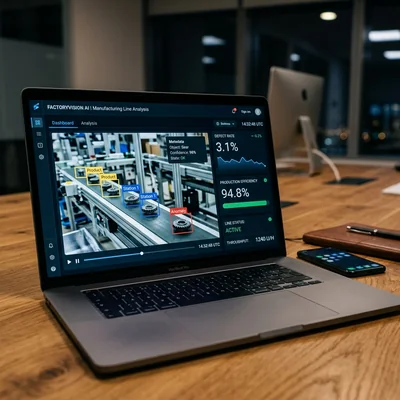
Computer vision (CV) is when cameras and AI models look at photos or video and answer business questions: is there a defect on a part, is a parking spot free, does the shelf match the planogram, who entered the hall. It is not “camera magic,” but a chain camera → model → rule → action in your systems. Below - where CV actually pays off, what makes up the budget, and how much a pilot, cloud API, and industrial rollout cost in 2026.
- Core idea - a model recognizes objects, defects, text, faces, or events in images and video
- Where it works - manufacturing, retail, logistics, security, documents, agriculture
- API budget - from $0.50-3 per 1,000 frames on cloud services; SaaS - $100-2,000/mo
- Pilot (MVP) - usually $3,000-15,000 and 3-8 weeks
- Production on a line / store chain - $20,000-120,000+ with cameras, integrations, and training
- Main risk - buying an “AI camera” without data, quality metrics, and a process owner
What Computer Vision Is in Plain Language
A regular camera records a picture. Computer vision extracts meaning for a decision:
- “a cracked part on the conveyor”;
- “SKU A is out on the shelf”;
- “plate ABC123 at the entrance”;
- “queue longer than 5 people at checkout”;
- “passport scan: name and series recognized”.
Technically this is a family of models: classification, object detection (often YOLO and peers), segmentation, OCR, people/vehicle tracking, sometimes face recognition. For business, the model name matters less than accuracy on your data, latency, and the link to ERP, CRM, WMS, or MES.
Unlike “vendor video analytics”: a boxed product is fine for typical scenarios (perimeter, footfall). Custom work in Python is needed when the object is specific, accuracy requirements are strict, or deep process integration is required.
Where Businesses Apply It
| Industry | Typical tasks | Business value |
|---|---|---|
| Manufacturing | Quality control, missing parts, positioning | Less scrap, less manual QC |
| Retail | Empty shelves, planogram, queues, shrinkage | Better availability, faster reaction |
| Logistics & warehouse | Pallets, barcodes, damaged packaging, loading | Fewer shipping errors, faster receiving |
| Security | Access zones, left objects, PPE (helmet/vest) | Fewer incidents and fines |
| Documents | OCR of invoices, waybills, IDs, receipts | Faster data entry, fewer errors |
| Auto & transport | Plates, parking, video telematics | Gate automation and billing |
| Agriculture | Plant disease, ripeness, fruit counts | Better treatment and harvest decisions |
| Healthcare / labs | Image labeling, object counts (under clinician control) | Faster routine - not a doctor replacement |
Not every task pays equally. Best ROI is where human error is expensive and repeated: line defects, empty top SKUs, warehouse mis-picks.
Typical Scenarios and Effect Ranges
1. In-line quality control
A camera over the line captures the product; the model flags a defect; the line rejects or calls an operator.
- Effect: scrap reduction of 20-70% vs manual QC with stable lighting and a labeled set.
- Pilot length: 4-10 weeks.
- Risk: lighting changes, new SKUs, a “pretty demo set” without night shifts.
2. Retail: on-shelf availability (OSA)
Shelf photos 2-4 times a day or ceiling cameras → report “missing / low / wrong place.”
- Effect: sales lift from availability - often 1-3% category revenue where empty shelves were chronic.
- Timeline: 3-8 weeks for a pilot in 1-3 stores.
- Risk: different fixtures, glare, staff blocking the shelf - needs adaptation to your format.
3. Warehouse and logistics
Code reading, pallet composition checks, damage capture at receiving.
- Effect: fewer hours of manual scanning, fewer customer claims.
- Timeline: 4-12 weeks with WMS integration.
- Risk: dust, film reflections, non-standard packaging.
4. Document OCR
Scan → field recognition → draft into 1C / ERP / spreadsheet.
- Effect: invoice entry in 30-90 seconds instead of 5-15 minutes.
- Timeline: 2-6 weeks for typical forms; longer for messy scans.
- Risk: bad scans, handwriting, strict personal-data rules.
5. Safety and compliance
Hard hat on site, entry into a forbidden zone, abandoned luggage.
- Effect: fewer fines and downtime; sometimes lower insurance risk.
- Important: legal workflow (notices, video retention, biometrics) is a separate budget line.
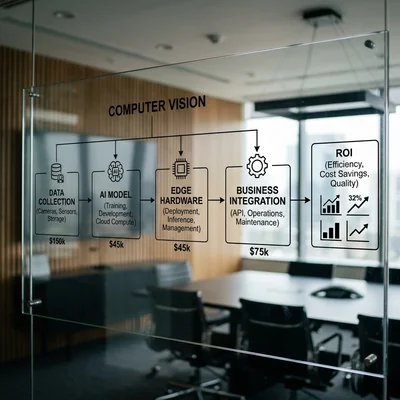
What Makes Up the Cost
A full CV budget is not only “the neural net.”
| Block | What is included | Share in a typical project |
|---|---|---|
| Data | Capture, labeling, augmentation, test set | 15-35% |
| Model | Training / fine-tuning, metrics, quality regression | 15-30% |
| Software & integrations | API, dashboard, ERP/MES/WMS/CRM link | 15-35% |
| Hardware | Cameras, lighting, edge PC / GPU, network | 10-40% |
| Rollout | Mounting, calibration, staff training, SOP | 10-20% |
| Operations | Cloud, power, retraining, support | recurring |
Without a data block the project almost always fails: a model trained on someone else’s photos poorly sees your defects and your shelves.
How Much It Costs: 2026 Ranges
Figures are market ranges (CIS / Eastern Europe / remote vendors). Exact quotes depend on camera count, FPS, accuracy, and integrations.
Level A - cloud APIs and ready services
| Solution | Price range | When it is enough |
|---|---|---|
| Google / AWS / Azure Vision, OCR | $0.50-3 per 1,000 images; specialty APIs cost more | Typical OCR, labels, basic detection |
| Face / SafeSearch / moderation API | by provider tariff, often $1-10 / 1,000 | Content moderation, simple checks |
| Retail / people / parking SaaS | $100-2,000/mo + camera install | Typical scenario, no unique object |
| No/low-code CV platforms | $200-1,500/mo | Fast pilot, little custom logic |
Pros: fast start. Cons: data may go to a provider (or you need on-prem), a custom defect like “scratch on our alloy” may fail without your own model.
Level B - pilot / MVP for your task ($3,000-15,000)
Usually includes:
- 1 site, 1-4 cameras or a photo pack;
- collect and label 500-5,000 examples;
- detection/classification model with a precision/recall report;
- simple UI or webhook to Telegram / sheet / ERP;
- report: whether to scale and under what conditions.
Timeline: 3-8 weeks.
Who builds it: ML engineer + integrator; part of the logic in Python.
Level C - industrial production ($20,000-120,000+)
When needed: several lines / stores, SLA, 24/7, legally significant decisions, hard latency (edge), link to conveyor reject.
Adds on top of the pilot:
- stable lighting and mounting;
- edge inference (not every frame must go to the cloud);
- model-drift monitoring (quality drops - alert);
- roles, event log, MES/WMS integration;
- SOP: who reacts to an alert within 2 minutes.
Hardware ranges (beyond software):
| Item | Range |
|---|---|
| Industrial camera + lens | $200-2,000 / point |
| Lighting / housing / mount | $100-800 / point |
| Edge PC with GPU | $800-5,000 |
| On-site inference server | $3,000-20,000+ |
Level D - enterprise and R&D ($100,000-500,000+)
Several plants, a unified labeling platform, MLOps, weekly retraining on new SKUs, a dedicated team. Here CV is a company product, not a one-off vendor project.
Three First-Year Budget Scenarios
Scenario A - invoice OCR for a small business
| Line | Amount |
|---|---|
| Cloud OCR / document SaaS | $600-2,400/year |
| Field setup and accounting integration | $1,000-4,000 |
| Form tweaks | $500-2,000 |
| Year 1 total | ~$2,500-8,000 |
Payback often in 1-3 months if accounting spends hours on manual entry.
Scenario B - quality control on one line
| Line | Amount |
|---|---|
| Pilot + hardening to production | $10,000-35,000 |
| Cameras, light, edge | $2,000-10,000 |
| Line / MES integration | $3,000-15,000 |
| Support and retraining | $3,000-12,000/year |
| Year 1 total | ~$20,000-70,000 |
ROI is counted from scrap and downtime cost: if a line loses $2,000-10,000/mo to defects - the project can make sense.
Scenario C - 20-store chain (shelves + queues)
| Line | Amount |
|---|---|
| SaaS or own platform | $10,000-40,000 |
| Cameras / edge across stores | $15,000-60,000 |
| Rollout and staff training | $5,000-20,000 |
| Cloud / connectivity / support | $6,000-24,000/year |
| Year 1 total | ~$40,000-140,000 |
Teams often start with 3-5 pilot sites, not all 20 at once.
Hidden Costs People Forget
| Item | Range | If ignored |
|---|---|---|
| Data labeling | $0.05-0.50 per object/frame or $500-5,000 packs | Model “lies” in prod |
| Retraining on new SKUs | $500-5,000 / wave | Accuracy drops in a month |
| Lighting and mounting | often more than the model at start | False positives |
| Video storage and compliance | $50-500+/mo + legal | Fines, employee claims |
| False alerts (noise) | shift time | People turn the system off |
| Edge-site internet | VPN, backup link | Analytics downtime |
The most expensive hidden cost is a system nobody uses: alerts flood in, and the shift lead ignores them. CV without a process owner is an expensive screensaver.
When You Should Not Deploy (Or Not Yet)
- No clear KPI: “we want AI on cameras” with no cost of error.
- Too few defect / empty-shelf examples - nothing to train on.
- The process itself is chaotic: a perfect camera will not fix missing SOPs.
- You demand 99.99% with no budget for hardware, data, and human oversight.
- You legally cannot film the area - settle consent and notices first.
In those cases a manual checklist + targeted OCR or a delayed pilot is cheaper than “full plant automation” on day one.
How to Choose: API, SaaS, or Your Own Model
Is the task typical (invoice OCR, people, license plate)?
        │
        ├─ yes → cloud API / SaaS (fast pilot)
        │
        └─ no → unique defect / shelf / part
                    │
                    ├─ few frames, no SLA → SaaS pilot + labeling
                    │
                    └─ hard SLA, plant floor, data cannot leave
                              → own model + edge + integrations
In practice many companies start with API/SaaS for 4-6 weeks, build their own sample set, then decide whether custom work and fine-tuning are needed.
Bottom Line
Computer vision for business pays off where human eyes tire and mistakes cost money: scrap, shelves, warehouse, paperwork, safety. Budgets start at cloud cents per thousand frames and reach hundreds of thousands of dollars for an industrial network with MLOps.
Three numbers before you start:
- Monthly cost of the error (scrap, out-of-stock, mis-picks) - ROI starts here.
- Pilot budget - usually $3,000-15,000, not “turnkey plant” on day one.
- Quality metric (precision/recall / false-alert rate) without which you must not go to production.
The winning path is one scenario, a measurable pilot, then more cameras and sites. Buying “smart cameras” without data and a process owner almost never pays off.
If you need help with development, AI implementation, or website support for your project - contact me.
Frequently Asked Questions
How is computer vision different from regular video surveillance?
Video surveillance records and shows a picture to a person. Computer vision extracts events and objects itself: a defect, an empty shelf, a person without a hard hat - and can create a task in a system or stop a line. Cameras are often the same; what changes is the analytics layer and business-process integration.
How much does a minimal CV pilot cost?
For one task and one site, a realistic range is $3,000-15,000 and 3-8 weeks: data, a baseline model, a simple alert/report. OCR on typical documents via the cloud can fit in $1,000-5,000 with setup. If a vendor quotes $80,000 without pilot metrics - ask to split scope into MVP and phase 2.
Are a GPU and your own server mandatory?
No. Many scenarios (OCR, infrequent shelf photos, moderation) run on a cloud API with no GPU of your own. Your own edge/GPU is needed when there are many frames per second, video cannot leave the site, or latency is critical (conveyor reject). Pilots often run in the cloud; production inference moves on-site.
Can you deploy computer vision without a dataset?
Almost never for unique tasks. Ready models and APIs cover typical cases (text, people, common objects). Your scrap, your shelf, your part need your labeled examples - at least hundreds, preferably thousands. Without data you only get an expensive “maybe it will work” experiment - it usually does not.
How do you know if the project pays back in a year?
Estimate the monthly damage (scrap × unit cost, lost sales from empty shelves, hours of manual entry). Compare it to pilot TCO + year-one operations. If damage is 3-5× higher than the annual CV budget for that scenario - a pilot makes sense. If damage is “we feel it but have no numbers” - measure a 2-4 week baseline manually, then compute ROI.
Terms in this article
CV — Computer Vision
SaaS — Software as a Service
MVP — Minimum Viable Product
production — live environment serving real users
SKU — Stock Keeping Unit
latency — delay before a response arrives
OCR — Optical Character Recognition
ERP — Enterprise Resource Planning
CRM — Customer Relationship Management
ROI — Return on Investment
downtime — period when the service is unavailable
fine-tuning — additional training of a model on domain data
regression — bug where a previously working feature breaks again
dashboard — metrics/status panel
GPU — Graphics Processing Unit
SOP — Standard Operating Procedure
low-code — building apps mostly visually, with some custom code
webhook — HTTP callback when an event happens
inference — running a trained model to get predictions
SLA — Service Level Agreement
ML — Machine Learning
hardening — security baseline: updates, least privilege, locked configs
backup — copy kept for recovery
VPN — Virtual Private Network
KPI — Key Performance Indicator
baseline — reference measurement before changes
TCO — Total Cost of Ownership