AI Regulation in the US, Europe, Russia, and the CIS - What Businesses Need in 2026

You deploy AI in CRM, a chatbot, or RAG over a knowledge base - and legal asks about personal data, decision transparency, and "high risk" under the EU AI Act. AI regulation in 2026 is no longer theory for Big Tech: it affects API choice, log retention, consent copy, and Python service architecture. Below is how rules work in the US, EU, Russia, and CIS countries, what actually matters for SMBs, and a practical checklist before production launch.
- US - no single federal law; sector rules, FTC, state laws (Colorado, California)
- EU - EU AI Act with phased rollout; from August 2026, stricter for high-risk systems
- Russia - personal data law, data localization, regulatory sandboxes (EPR), draft standalone AI law
- CIS - mostly strategies and targeted acts; practices imported from Russia and the EU
- For business - what matters is data, transparency, human-in-the-loop, and the LLM provider contract
- Main risk - hallucinations plus client data leaked into a public model without a DPA
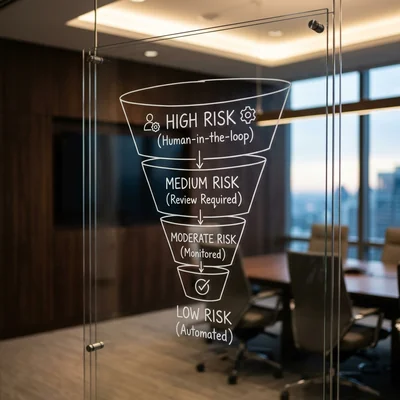
Why Regulation Is Not Just for Corporations
Small businesses often think: "we are not OpenAI, nobody will audit us." In practice, claims come from clients, partners, and personal-data regulators, not from an "AI inspection service."
Typical triggers:
- a chatbot processes name, phone, orders - that is personal data;
- lead scoring affects access to a service or price - that is an automated decision;
- RAG pulls internal policies and contracts into the model context;
- prompt logs sit on a provider server in another jurisdiction;
- staff paste client databases into ChatGPT "for a draft reply."
Practical takeaway: AI regulation almost always intersects data protection, consumer law, and contractual liability. The AI law adds a layer of risk classification and transparency duties.
United States: Fragmented Market Without a Single AI Act
The US has no federal law at EU AI Act level. Regulation is assembled from:
| Source | What it governs | For business |
|---|---|---|
| FTC | Unfair practices, misleading ads, "black box" without explanations | AI marketing, bots with false promises |
| Sector agencies | FDA (health), CFPB (finance), EEOC (hiring) | High-risk industries |
| State laws | Colorado AI Act, California rules on automated decisions | Companies with users in those states |
| NIST AI RMF | Voluntary risk management framework | Checklist for enterprise buyers |
| Contracts and DPA | Subprocessor data handling | Main lever for SaaS and API |
What SMBs with US Clients Should Know
- Transparency - users should understand they talk to AI, not a human (where platform policy or state law requires it).
- Opt-out of automated decisions - in some states for significant decisions (credit, insurance, hiring).
- DPA with OpenAI / Anthropic / Google - fix whether data is used for training, storage region, log retention.
- Human review - for legally significant answers, the bot is not the final arbiter.
2025-2026 trend: more state initiatives, less single federal text. If you sell in the US, look beyond Delaware to users' states.
Europe: EU AI Act and GDPR Overlap
The EU AI Act is the first major horizontal AI law. Systems are split by risk level:
| Class | Examples | Obligations |
|---|---|---|
| Unacceptable | State social scoring, manipulative techniques | Ban |
| High risk | Hiring, credit, medicine, critical infrastructure | Certification, documentation, monitoring, human oversight |
| Limited risk | Chatbots, deepfake content | Labeling, user notice |
| Minimal risk | Spam filter, recommendations without legal effect | No special AI Act duties |
Timeline Relevant to 2026
- February 2025 - ban on unacceptable practices
- August 2025 - rules for GPAI (foundation models) and governance
- August 2026 - full requirements for high-risk systems (key date for many B2B scenarios)
- 2027 - high-risk embedded in products
GDPR remains: lawful basis, DPIA, data-subject rights, cross-border transfer. AI does not cancel EU data protection - it strengthens questions of who is controller, where prompts go, and whether decisions are explainable.
Practice for the European Market
- Website chatbot - often limited risk: mark "you are talking to AI", offer a path to an agent.
- Lead scoring without service denial - usually below high-risk, but DPIA still makes sense at scale.
- Automatic credit / insurance denial - high-risk: do not go live without legal review.
- RAG on internal docs - watch log retention and subprocessors in the DPA.
Russia: Personal Data, Localization, and Sandboxes
Russia does not yet have a standalone "AI Act" in force, but the active field is already strict for business:
| Norm | Essence | AI impact |
|---|---|---|
| 152-FZ | Personal data, consent, subject rights | Any bot with name, phone, email |
| Localization | Primary recording of Russian citizens' data in Russia | Hosting, DB, logs choice |
| Cross-border transfer | Restrictions and notices | OpenAI API / foreign LLMs |
| EPR sandboxes | Digital experiment zones | Pilots with relaxed rules in sandbox areas |
| National AI strategy | Development priorities, ethics | Public sector, large vendors |
Typical Patterns for Russian SMBs
- Russian VPS + self-hosted or corporate API with a data-processing agreement.
- De-identification before sending to a public model - not a cure-all, but lowers risk.
- Prompt logs - retention policy, access, deletion on request.
- Processing consent - separate clause on automated processing and AI where applicable.
Important: sending client cards from CRM to a foreign chat without legal basis is a common mistake. Data model and contract first, then integration.
CIS: Strategies Without One Standard
CIS countries are less synchronized than the EU, but that is not a "rule-free zone" for regional revenue.
| Country | Status (2026) | Practical focus |
|---|---|---|
| Kazakhstan | AI development concepts, public digitalization | Contracts, personal data, EU practices on export |
| Belarus | Digital economy decrees, IT parks | HTP regime, contractual architecture with clients |
| Uzbekistan | Digital Uzbekistan strategy | Local partners, public sector |
| Armenia, Kyrgyzstan | Early frameworks, shared principles | GDPR-like expectations from Western partners |
CIS rule: if the product targets EU or US, aim for the strictest contour among target markets, not the minimum of the home jurisdiction.
Comparison: What to Check Before Launch
| Question | US | EU | Russia / CIS |
|---|---|---|---|
| Single AI law | No | EU AI Act | Draft / strategies |
| Personal data | Sector + state | GDPR | 152-FZ and local analogs |
| Chatbot labeling | State / policy dependent | Often mandatory | Recommended, growing demand |
| High-risk automated decisions | States, sectors | Strict from 2026 | By sector + personal data |
| LLM provider contract | Critical | Critical | Critical + cross-border |
| Human-in-the-loop | Best practice | Required for high-risk | Best practice + fewer hallucinations |
Practical Checklist for AI Rollout
Before pilot (1-3 days):
- describe the scenario: which data goes in, which decisions come out;
- classify risk: marketing FAQ vs service denial;
- choose provider: public API vs corporate / on-prem;
- check DPA: training on data, region, log retention.
During pilot (2-6 weeks):
- mask personal data in prompts;
- limits on tokens and context leakage;
- error log and escalation to a human;
- A/B on answer quality, not only "nice wording."
Before production:
- site policy + consent if personal data is processed;
- staff guide: what must not be pasted into a public chat;
- incident plan: who disables the bot, who emails clients;
- legal review for high-risk or regulated industries.
When a "Light" Regime Is Enough
A light regime is usually enough if:
- the bot answers FAQ without open personal data access;
- decisions do not affect price, credit, hiring, medicine;
- there is a "call an agent" button and logs for review;
- RAG runs on de-identified or public documents.
You need legal and formal compliance if:
- automatic denial / approval of applications;
- biometrics, voice, video analytics;
- children's data or sensitive personal-data categories;
- public procurement or critical infrastructure.
Summary
AI regulation in the US, Europe, Russia, and the CIS in 2026 is not one law but overlapping requirements: personal data, transparency, risk classification, provider contracts. For most SMBs, sound architecture (data, logs, human-in-the-loop) and honest bot labeling are enough - without giving up AI in CRM. For high-risk and regulated sectors, budget legal/compliance before development, not after the first notice.
Need an AI project assessment with regulatory requirements in mind - contact me.
Frequently Asked Questions
Does the EU AI Act apply if the company is in Russia but clients are in the EU?
Yes, if you place the product on the EU market or process EU residents' data as controller/processor. Company jurisdiction does not cancel GDPR and AI Act extraterritorial effect. Typical exporter path: DPIA, EU representative contract if needed, bot labeling, DPA with the LLM provider. If clients are only in Russia - follow 152-FZ, but EU partners will still ask about subprocessors.
Can you use ChatGPT / Claude for website leads in Russia?
Only with legal basis and data-flow control. A public chat with client personal data copied in - high risk under 152-FZ and cross-border transfer. Working options: enterprise tier with DPA and training disabled, Russian hosting of a middleware layer with de-identification, on-prem / local model for sensitive scenarios. Before production - consent and processing policy, not only technical integration.
Must you mark that AI, not a human, answered?
In the EU - often yes (limited risk under AI Act). In the US - depends on state and industry. In Russia and the CIS there is no single formal rule for all bots yet, but labeling reduces claims on misleading advertising and builds trust. Minimum: "This answer was generated with AI. For an exact quote, contact a manager" + escalation button.
How do you know if lead scoring is high-risk?
Look at consequences for the person. If scoring only prioritizes the manager queue and does not auto-deny service - usually below EU high-risk threshold. If scoring automatically rejects applications, changes price or contract terms without a human - high-risk zone and legal review needed. When in doubt, add human review on the final step.
How much does it cost to "compliance-proof" an AI project?
Light FAQ bot without personal data - often $0 on top of development if architecture is clean from day one. CRM bot with personal data and EU clients - $1,500 - $5,000 for legal review, policies, DPA, and checklist (excluding regulator litigation). High-risk or fintech/health - $10,000 - $50,000+ for formal compliance, AI Act documentation, and audit. Cheaper to budget 2-5 days of analyst and legal time upfront than to rebuild production after an incident.
Terms in this article
CRM — Customer Relationship Management
chatbot — conversational bot interface
knowledge base — structured repository of answers/docs
RAG — Retrieval-Augmented Generation
retention — keeping users/customers over time
production — live environment serving real users
human-in-the-loop — human approval before risky agent actions
LLM — Large Language Model
DPA — Data Processing Agreement
lead scoring — ranking leads by likelihood to buy
consumer — queue/stream consumer
SaaS — Software as a Service
human review — manual check by a person
GDPR — General Data Protection Regulation
DPIA — Data Protection Impact Assessment
self-hosted — software you run on your own servers
sandbox — isolated environment for safe experiments and tests
VPS — Virtual Private Server
on-prem — software hosted in your own infrastructure
middleware — code layer between request and business logic