Blog — page 5

Rufat Nuriyev updated

CRM system interface with sales funnel on a laptop screen

CRM is a system that stores clients, deals, tasks, and the full communication history. In simple terms: instead of Excel spreadsheets, personal Telegram chats, and manager notebooks - one source of truth showing who the client is, what stage the deal is at, and what to do next. Below - what CRM really is without marketing noise, who actually needs it, how much it costs, and when the investment pays back.

  • CRM - unified database of clients, deals, tasks, and contact history
  • Without CRM leads get lost, calls duplicate, sales forecasts disappear
  • Needed when you have 2+ managers, 50+ active clients, or a long sales cycle
  • Can wait if you are solo with up to 30-50 repeat clients
  • Cost - from $0 (free tiers) to $50-150/user/month for a team
  • Payback - usually 6-18 months with a 5-15% conversion lift
Read more

Rufat Nuriyev updated

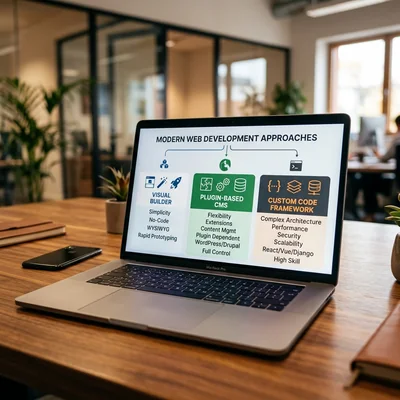
Comparison of builder, CMS, and custom development on a laptop screen

Tilda, WordPress, and a Django site are three different answers to one question: "how do I build a website for my business?" Tilda is a cloud website builder: pages from blocks, hosting included, launch in days. WordPress is a PHP CMS on your or managed hosting: themes, plugins, WooCommerce for stores. Django is custom development in Python: unique logic, APIs, customer portals, full control over code. For a business owner, the choice is not "what is trendier" but timeline, budget, flexibility, and who will maintain the site in 2-3 years. Below - who each option fits, real costs, typical mistakes, and a simple decision framework.

  • Tilda - landing, business card site, promos; from ~$5-15/mo; no developer at start
  • WordPress - blog, corporate site, store up to thousands of SKUs (stock keeping units); hosting + plugins from $10-80/mo
  • Django - custom logic, portals, integrations, API; development from $5,000-50,000+
  • Fast launch - Tilda (1-7 days), WordPress (2-6 weeks), Django (1-4+ months)
  • Main Tilda risk - platform ceiling and hard migration
  • Main WordPress risk - plugins, security, rising TCO (total cost of ownership) at scale
  • Main Django plus - you own the code; minus - team and budget needed upfront

Read more

Rufat Nuriyev updated

E-commerce store dashboard interface on a laptop screen

Shopify is a cloud e-commerce platform (SaaS): catalog, cart, payments, shipping, and admin are built in, with hosting and updates included in the plan. For a business owner, it is one of the fastest ways to start selling online without a development team - pick a theme, add products, connect a domain and payment provider. But Shopify is not a magic button: fees, paid apps, checkout customization limits, and vendor lock-in quickly change the TCO picture. Below: what Shopify does out of the box, real 2026 pricing, platform limits, and when you cannot avoid hiring a developer.

  • Shopify fits - D2C brands, small and mid-size e-commerce, multichannel sales (site + social + POS)
  • Plans - from $5/mo (Starter) to $399+/mo (Advanced); Shopify Plus from ~$2,300/mo
  • Hidden costs - 0.5-2% fee without Shopify Payments, apps ($10-100+/mo), theme, Liquid custom work
  • Without a developer - typical store up to 500-3,000 SKUs, standard shipping and payments
  • Developer needed - custom checkout (Plus), ERP, headless storefront, complex pricing and inventory logic
  • Main risk - ecosystem dependence: migrating catalog and orders to WooCommerce or Django is a separate project

Read more

Rufat Nuriyev updated

Website builder interface transitioning from visual blocks to code on a laptop screen

Wix is a cloud website builder (SaaS): you assemble pages in a visual editor, and hosting plus platform updates are already included. For a business owner, it is a fast path to a landing page, business card site, or small online store without hiring a development team. But Wix has a flexibility ceiling: custom logic, complex integrations, and scaling often hit platform limits - then you need Velo (JavaScript code) or a move to WordPress / Django. Below: who Wix fits, real costs in 2026, and when it makes sense to hire a developer.

  • Wix fits - landing pages, business sites, portfolios, small e-commerce up to ~500-2,000 SKUs, quick MVP
  • Plans - from $0 (Free) to $159+/mo (Business Elite); e-commerce from ~$29-36/mo
  • Hidden costs - domain, App Market apps, payment fees, Velo custom work
  • Developer needed - Velo, API integrations, migration, non-standard SEO, going beyond platform limits
  • Main risk - vendor lock-in: moving content and logic to another stack is harder than it looks

Read more

Rufat Nuriyev updated

No-code website builder interface on a laptop screen

A website builder is a service where you assemble pages from blocks in a visual editor without programming: text, forms, catalog, payments - out of the box. For a business owner it is a fast path to a landing page, business card site, or simple store: Tilda, Nethouse, Wix, Webflow, and dozens of alternatives promise launch in days, not months. But "no code" does not mean "no limits": each platform has its ceiling for SEO, integrations, export, and cost as you grow. Below - who each builder fits, what it costs, when a $10-30/mo plan is enough, and when WordPress, custom development, or at least moving to your own hosting makes more sense.

  • Tilda - strong for landing pages and design (Zero Block), popular in CIS; store and CRM with limitations
  • Nethouse - simple start for small business in Russia/CIS, domain and hosting "in one window"
  • Wix - universal builder with App Market, good for showcase and basic e-commerce
  • Webflow - flexible layout and CMS for designers; more capable than typical builders, but harder and pricier
  • When a builder is enough - landing, 10-30 pages, leads, catalog up to hundreds of items without complex logic
  • When to move on - unique account area, ERP, heavy catalog, strict SEO and speed requirements

Read more

Rufat Nuriyev updated

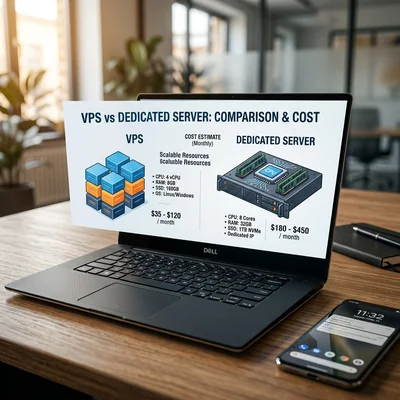
Comparison of VPS and dedicated server on a laptop screen

VPS (virtual private server) is your isolated virtual machine on shared physical hardware: you pay for a guaranteed share of CPU, RAM, and disk, get root access and your own IP. A dedicated server is an entire physical machine in a datacenter just for you: no neighbors at the hypervisor level, maximum performance and control, but a higher price. For a business owner, the choice is not "what ranks higher in benchmarks" - what matters is traffic, budget, SLA, and who will administer the server. The mistake of "we took dedicated for future growth" wastes $200-400/mo; the mistake of "we stay on VPS when disk and IOPS are not enough" means downtime during peak sales and reputational damage.

  • VPS - from $10-80/mo: e-commerce, API, several sites, start of custom development
  • Dedicated - from $80-500+/mo: high load, strict isolation requirements, predictable I/O
  • When VPS is enough - up to 50,000-100,000 visits/day (depends on stack), no extreme peaks
  • When you need dedicated - heavy databases, video, 1C on server, compliance requiring "our hardware only"
  • Main VPS advantage - flexible scaling in the panel in minutes; easier backup and migration
  • Main dedicated advantage - stable performance without "noisy neighbors" on the hypervisor

Read more

Rufat Nuriyev updated

Infographic of interactive UI component costs on a laptop screen

JavaScript is the language that brings your site to life in the browser: the cart updates without a page reload, prices are calculated, the catalog is filtered, and the user account opens. Owners ask for "a calculator like the competitor's" or "a filter with 12 parameters," and quotes range from $300 to $40,000 - with no clear sense of what is fair. Below are real budget ranges for the three most common customizations in 2026, what is included, when a plugin is enough, when you need a frontend developer, and hidden costs that eat the budget after delivery.

  • Simple calculator (3-7 fields, client-side formula) - $300-1,500, 2-7 days
  • Complex calculator (PDF, email, CRM, multi-step) - $2,000-8,000, 2-5 weeks
  • Catalog filter (no reload, up to 500 SKUs) - $800-3,000, 1-2 weeks
  • Heavy filter (10,000+ products, AJAX, SEO) - $3,000-12,000, 3-6 weeks
  • User account (login, 3-5 sections on CMS) - $3,000-15,000, 3-8 weeks
  • SPA user account (React/Vue, API, roles) - $15,000-60,000+, 2-5 months
  • Main price driver - not "JavaScript itself," but the tie-in with backend, data, and design

Read more

Rufat Nuriyev updated

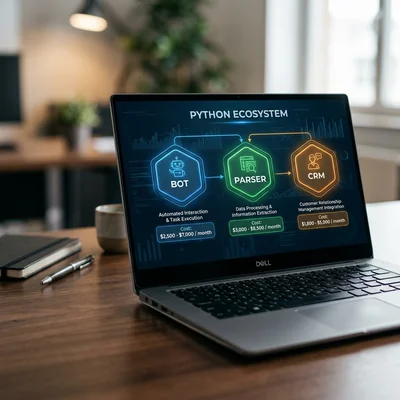
Infographic of Python development costs on a laptop screen

Python is the most common choice for business automation: messenger bots, competitor price scrapers, lead sync with CRM, background jobs, and APIs. Clients hear "Python is fast and cheap," then the quote shows $25,000 and three months - because price is driven not by the language but by logic scope, integrations, and reliability requirements. Below are realistic 2026 ranges for three typical tasks: bot, parser, CRM integration, what each tier includes, and how to avoid paying for an "MVP you cannot run in production."

  • Simple Python bot (FAQ, notifications, menu) - $800 - $3,500, 1-3 weeks
  • Bot with CRM, payments, roles - $5,000 - $20,000, 3-8 weeks
  • Parser "scrape once and export to Excel" - $700 - $2,500, 3-10 days
  • Scheduled parser with DB and monitoring - $3,000 - $15,000, 2-6 weeks
  • CRM integration (form lead to Bitrix24/amoCRM) - $1,500 - $6,000, 1-3 weeks
  • Two-way CRM + ERP + warehouse sync - $12,000 - $50,000+, 1-4 months
  • Monthly costs - VPS, APIs, support: from $30 to $2,500+
  • Main price driver - not Python, but number of integrations, edge cases, and SLA

Read more

Rufat Nuriyev updated

Comparison of plugins and custom PHP development on a laptop screen

WordPress on PHP is the most common way to launch a company website without a development team: landing page, blog, catalog, WooCommerce store. The plugin ecosystem covers 80% of typical tasks - forms, SEO, cache, backups, CRM integration "in one click." But as soon as business logic goes beyond admin settings, the owner faces a question: is one more plugin enough, or is it time to pay a PHP developer? Below - where the line is, what both paths cost, the risks of a "plugin zoo," and when it makes more sense to look at migration to another stack instead of endlessly patching PHP.

  • Plugins are enough - content, forms, basic SEO, WooCommerce up to 500-2,000 SKUs, standard integrations
  • You need a developer - custom logic, API, heavy filters, security, performance as load grows
  • Typical setup - $300-1,500 one-time; theme and PHP customization - $50-120/hour or fixed from $1,000
  • Main plugin risk - update conflicts, security holes, tech debt in functions.php
  • Rule - if a task cannot be described in a spec without the word "custom," it is development, not "one more module"

Read more

Rufat Nuriyev updated

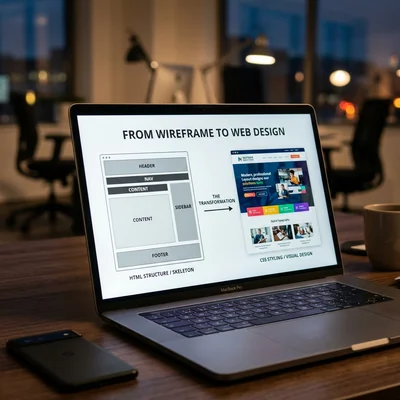
Diagram of HTML to CSS transformation on a laptop screen

CSS (Cascading Style Sheets) is the language of site styling: colors, fonts, spacing, block layout, and adaptation to phone screens. If HTML defines the page "skeleton" and JavaScript handles button and form behavior, then CSS controls how everything looks on a monitor and in your customer's pocket. When an owner says "the site breaks on mobile," styles are almost always to blame: fixed width, tiny text, a "Buy" button off-screen, horizontal scrolling, a form you cannot fill with a thumb. In 2026, more than half of leads on commercial sites come from mobile - bad layout hits conversion directly, not "we'll fix it someday."

  • CSS - styling: colors, fonts, grid, adaptation to different screens
  • "Site breaks" - horizontal scroll, overlapping blocks, clipped text, buttons outside the tap zone
  • Why owners care - mobile customers do not wait for a "desktop version"; they go to a competitor
  • Stack - HTML (structure) + CSS (look) + JS (interactivity); without CSS the page is bare text
  • Main risk - a beautiful Figma mockup on desktop and a broken cart on iPhone

Read more

Contacts